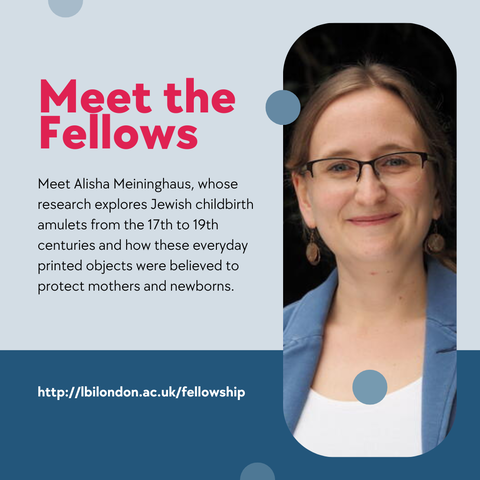
The latest feature in the Leo Baeck Institute’s Meet the Fellows series introduces Alisha Meininghaus, whose PhD research on Jewish childbirth amulets from the 17th to the 19th century sheds light on a relatively unexplored field, connecting Jewish women’s history, material religion and the history of printing.
Can you briefly describe your doctoral research project for a non-specialist audience? What inspired you to pursue this topic?
In my dissertation, I am researching printed Jewish childbirth amulets from the 17th to 19th centuries in German-speaking regions. These amulets were primarily intended to protect mothers and newborn children from the demon Lilith. I am particularly interested in the question of which iconographic, linguistic, and cultural factors may have contributed to these very simple and mass-produced objects being attributed with effective power. My interest in Jewish amulets was sparked during my time at the Museum of Religions in Marburg, which houses several Jewish amulets from Israel.
How does your current work engage with wider themes or ongoing debates in your academic field?
I work as a curator for education at the Jewish Museum of Franconia in Fürth (Bavaria). Among other things, we design guided tours and workshops on Jewish religious history and antisemitism. This work incorporates many debates and questions from the fields of religious studies and Jewish studies.
In what ways did your studies or experiences prepare you for your doctoral research and the work you are doing now?
My studies in Religious Studies and Jewish Studies provided excellent background knowledge and a solid foundation for my dissertation as well as for my current work at the museum.
What have been the most rewarding and most challenging aspects of your academic journey so far?
The biggest challenge for me so far has been balancing my ongoing dissertation with my full-time job at the museum. I am very happy that I can pursue a cumulative doctorate, which allows for a better balance between academic work and my career. The best part of my academic engagement with Jewish amulets is to bring greater attention to a field of research that has been relatively under-explored in the fields of religious studies and Jewish studies, and of developing theories in this area that, in the best case, add value to both disciplines.
How has the LBI fellowship influenced your research and academic progress?
The LBI fellowship has enabled me to network with other scholars researching Jewish topics beyond the boundaries of my own academic disciplines. This has allowed me to incorporate insights from fields such as linguistics and art history into my work. In addition, the fellowship allowed me to focus intensively on research and initial conceptual considerations during the early stages of my dissertation.
If you could share one insight or piece of advice with future researchers interested in German-Jewish studies, what would it be?
I would advise them to muster the courage to write an academic thesis in this field. Even though doctoral studies often take quite a long time and require a great deal of perseverance, the field of German-Jewish studies offers so many exciting and as yet unexplored research topics.
Is there a book, artwork, or historical figure that has particularly inspired you in your studies?
A poem by Rose Ausländer ends with the words, “Be what you are. Give what you have.” For me, that is a very beautiful motto, both for my personal life and for my academic career.