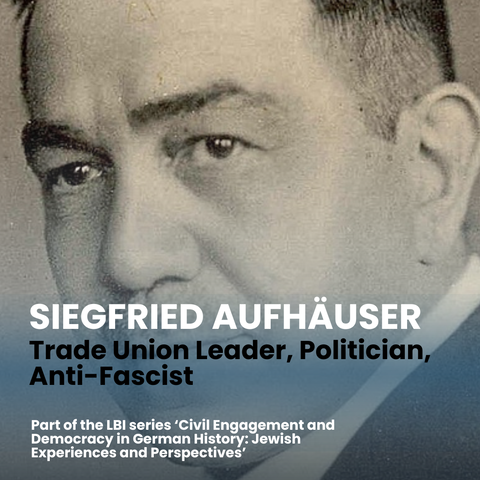
Siegfried Aufhäuser (1880 - 1969) was one of the Weimar Republic’s most prominent trade unionists and socialist politicians. A committed democrat and staunch opponent of National Socialism, he was a tireless advocate for the rights of salaried employees. He co-founded the General Federation of Free Employees (AfA-Bund) and served as its chair from 1921 until the organisation’s forced dissolution in 1933. From 1920, he represented first the Independent Social Democratic Party (USPD), and later the SPD, in the Reichstag, where he was widely regarded as a leading voice on the union left. Following Hitler’s rise to power, Aufhäuser went into exile - first in Prague, then in the United States - where he remained politically active, though increasingly isolated. He later returned to Germany and continued his lifelong advocacy for workers’ rights and democratic reform.
Christian Zech studied Political Science, History, and Communication Studies at the Universities of Mannheim and Hamburg, completing his doctorate at the Centre for Research on Antisemitism at the Technical University of Berlin. He has published on exile, the history of the press, and the development of businesses and cooperatives, including several biographical studies. Since 2020, he has worked as a research associate at the Historiker-Genossenschaft in Berlin.
Lutz Vössing spoke with Christian Zech about the life and legacy of Siegfried Aufhäuser.
What first sparked your interest in Siegfried Aufhäuser?
I first came across Aufhäuser’s name while researching the German-Jewish exile newspaper Aufbau, which began publication in New York in 1934. For a time, Aufhäuser served as deputy editor-in-chief, and in the papers of Aufbau’s editor, Manfred George, I found several letters from him - full of dry humour and sardonic reflections on the everyday routines of the newsroom. Later, while investigating socialist and trade union organisations in exile, his name kept appearing - usually in the context of internal disputes, ideological disagreements, or critical interventions. He was often described as serious, combative, and somewhat reserved. This mix of personal distance and political sharpness intrigued me.
What do we know about his family background?
Aufhäuser was born into a middle-class Jewish family and grew up in Augsburg. His father ran a cigar and spirits business, which had partly come from his mother’s side of the family. Both parents were raised in orthodox households, but Siegfried and his three siblings were brought up in a more secular, undogmatic spirit.
Did his background and early education influence his political orientation and later involvement in the labour movement?
His later commitment to social democracy and trade unionism wasn’t directly shaped by his family background. As the third of four children, he moved to Munich after completing primary school and a commercial apprenticeship, training as a commercial assistant. At the time, the role of the Angestellter - the salaried employee - was undergoing major changes. What had once been a potential stepping stone to entrepreneurial independence was increasingly defined by limited career prospects and worsening working conditions. These structural shifts prompted Aufhäuser to become active in a professional association that soon adopted more explicitly trade union demands.
Can you elaborate on this? How did he then enter politics?
From 1903, Aufhäuser became active in the Association of German Merchants and quickly distinguished himself through his commitment and organisational skill. After relocating to Berlin, he rose rapidly within the organisation. In 1908, a small liberal middle-class party was founded in the capital - the Demokratische Vereinigung (Democratic Union) - which explicitly aimed to represent the interests of salaried employees. Aufhäuser joined its ranks. Among its members were figures such as Tony and Rudolf Breitscheid and Hugo Sinzheimer. Although the party had little electoral success and dissolved during the First World War, it provided a valuable political platform for Aufhäuser.
Towards the end of the war, he joined the Independent Social Democratic Party (USPD), following the example of his wife, Anna Aufhäuser (née Stein), who had been politically active since 1904 and had moved to the USPD during the SPD split. When the parties reunited, both rejoined the SPD in 1922. By that point, Aufhäuser had already been a member of the Reichstag for a year, having been elected in 1921.
What influence did his wife Anna have on his political work?
A significant one. Anna Aufhäuser was six years older than Siegfried, politically active in the SPD long before him, and deeply involved in trade union work. Many sources suggest that the couple’s decisions - such as the choice to emigrate in 1933 or whether to return to Germany after the war - were made jointly, often after intense discussion. While her influence is not always explicitly recorded, it can be discerned throughout his political development.
This also points to a broader issue in biographical research: when the focus is on male protagonists, the role of women in their immediate environment often remains under-documented, even when it is clear they played a decisive role. Anna Aufhäuser initially had a public profile - she gave, for example, a speech on International Women’s Day in 1914 - but she gradually withdrew from public life following her marriage and the birth of their daughter, likely to support her husband’s career. After that, she is mentioned only rarely in contemporary sources.
Their daughter, too, had an important influence. In 1934, at the age of seventeen, she emigrated to Palestine. This prompted Aufhäuser to take a growing interest in the local trade union movement there.

Aufhäuser had a remarkable career as a trade union leader and Social Democrat. What would you highlight as his most significant political achievements?
In an interview shortly before his death, Aufhäuser himself pointed to his contributions to social policy and the development of social insurance during the Weimar Republic. He was especially proud of having, together with Carl Legien, called for the general strike that successfully resisted the Kapp Putsch in 1920.
He was deeply committed and politically effective in these fields. One of his major accomplishments was the organisation and politicisation of salaried employees, helping to secure their place within the broader labour movement. He also consistently advocated for the democratisation of the economy - a theme that remains highly relevant and contested today, and to which he contributed across several arenas.

What impact did he have in these areas?
Among the most tangible achievements were the Labour Courts Act of 1926 and the Unemployment Insurance Act of 1927, both of which he championed. These laws remain foundational to the German welfare state. Less successful - though significant in ambition - was the initiative known as the Neuordnung der Wirtschaft ( ‘restructuring of the economy’), a programme developed under Aufhäuser’s leadership and adopted by the Free Trade Union Federations and the SPD in 1932. It aimed to address the economic and political crises of the late Weimar period and to counter the growing appeal of National Socialism. As we know, these hopes were ultimately dashed.
In terms of salaried employees, Aufhäuser played a key role in uniting their various trade union associations into a single umbrella organisation with a clear labour orientation. He emphasised the common interests of workers and salaried staff - an approach that also attracted many employees who might otherwise have gravitated towards more conservative or bourgeois associations.
Aufhäuser fled to Prague and later New York after the Nazi seizure of power. How did his life in exile unfold?
By the early 1930s, Aufhäuser had become a prominent figure within the SPD leadership. In April 1933, he was elected to the party’s executive committee, but was forced to flee Germany just days later. After a brief period in Paris, he and his wife Anna settled in Prague in the autumn of 1933. There, he worked for a Czechoslovak employees’ union and contributed regularly as a journalist.
Following the Munich Agreement in 1938, the couple fled again - this time via London to New York, where they arrived in April 1939. In New York, Aufhäuser worked first for the émigré newspaper Aufbau, and later for the New Yorker Staats-Zeitung und Herold. His relationship with the SPD executive in exile was difficult; he was effectively sidelined in early 1935. During this period, he became involved with the Revolutionary Socialists, a group critical of the party leadership. Relations later improved somewhat: in the United States, Aufhäuser went on to serve as co-chair of the ‘German Labor Delegation’, which represented the SPD executive in exile.

Could you elaborate on his role in the SPD in exile (SoPaDe) and the Popular Front movement?
By way of background: the SPD’s executive body in exile, based in Prague, was known as SoPaDe. Aufhäuser served as a member, though only in the capacity of an unpaid assessor. In the spring of 1933, he undertook work in Paris on SoPaDe’s behalf. After settling in Prague later that year, he soon grew disillusioned. Decisions were increasingly made without his involvement, and he found himself at odds with the prevailing political line.
One source of tension was SoPaDe’s growing isolation from other socialist voices in exile. A number of new socialist groups had formed, openly challenging SoPaDe’s claim to be the sole legitimate representative of German social democracy - and its control over party funds. Aufhäuser advocated for a more open and inclusive approach, seeking to build bridges with these groups. His stance led to his formal exclusion from SoPaDe in early 1935, though cooperation resumed to a degree in the latter half of the 1930s.
Efforts to unite the fractured German opposition in exile culminated in initiatives like the ‘Lutetia Circle’ in Paris, where Social Democrats, Communists, and liberal opponents of National Socialism came together under the banner of a ‘Committee for the Preparation of a German Popular Front’. While SoPaDe remained largely aloof, Aufhäuser supported similar endeavours in Prague.
He returned to Germany in the early 1950s. How did he continue his political and trade union engagement?
Aufhäuser had already begun seeking contact with post-war Germany shortly after 1945 and explored various employment options from abroad. However, he was frequently advised to return first and look for work on the ground - making any return both personally and professionally uncertain.
Once back in Berlin, he initially received only minor assignments. Eventually, he found more stable footing with the German Employees’ Union (Deutsche Angestellten-Gewerkschaft, DAG). When the head of the union’s regional branch passed away in 1952, Aufhäuser was elected as his successor - a role he held until 1958. He placed great emphasis on improving relations with the rival German Trade Union Confederation (Deutscher Gewerkschaftsbund, DGB) and remained active in the SPD’s regional organisation. He continued to underline the strategic importance of salaried employees for economic development and for the SPD’s long-term political direction, contributing to the debates that would ultimately shape the Godesberg Programme.
From 1952 onwards, Siegfried and Anna Aufhäuser also reconnected with the Jewish Community of Berlin. In the late 1950s, Siegfried even stood for election to its representative council.

In what ways does his political engagement remain relevant for today’s trade unionists and social democrats? What can we learn from his life and work today?
Siegfried Aufhäuser’s life invites us to reflect on the complexities of political engagement and the contingency of historical developments. His career offers a striking reminder that history is rarely linear or preordained.
He was a clear-sighted critic of social and economic inequality and a tireless advocate for the democratisation of both the state and the economy. Even in moments of deep political crisis or personal setback, he remained pragmatic without abandoning his ideals. His example - combining principle with political realism, and vision with perseverance - remains an inspiration for anyone committed to sustaining and renewing democratic life in the face of contemporary challenges.
Text: Lutz Vössing
This article is part of the series ‘Civil Engagement and Democracy in German History: Jewish Experiences and Perspectives’, first published in German as Engagement & Demokratie in der jüdisch-deutschen Geschichte by the Freunde und Förderer des Leo Baeck Instituts. You can read the article in the original German here: https://fuf-leobaeck.de/2025/06/siegfried-aufhaeuser-gewerkschaftsfuehrer-politiker-antifaschist/