Skip to main content A Childhood in Exile: An Oral History | Leo Baeck Institute London

A Childhood in Exile: An Oral History

Featured image

This oral history interview records the experiences of a man who left Czechoslovakia as a young child in 1939 and grew up in wartime Britain. In these selected excerpts, he ref

lects on his family’s flight from Nazi persecution, the life he built in the United Kingdom, his assimilation, his schooling across different parts of Britain and a career that took him around the world. His early experiences shaped him, but it was his own ambition and curiosity that defined him.

The interview also reflects on the longer consequences of displacement: the relationship between childhood memory and family history, the experience of adapting to a new language and country, and the ways in which events understood only dimly as a child acquired greater meaning over time.

The interviewee has asked to remain anonymous. Certain biographical details have therefore been omitted or generalised, and all enquiries about the recording should be directed to the Leo Baeck Institute London.

Image top right: The interviewee as a young boy in Marienbad, Sudetenland,  today Mariánské Lázně in the Czech Republic


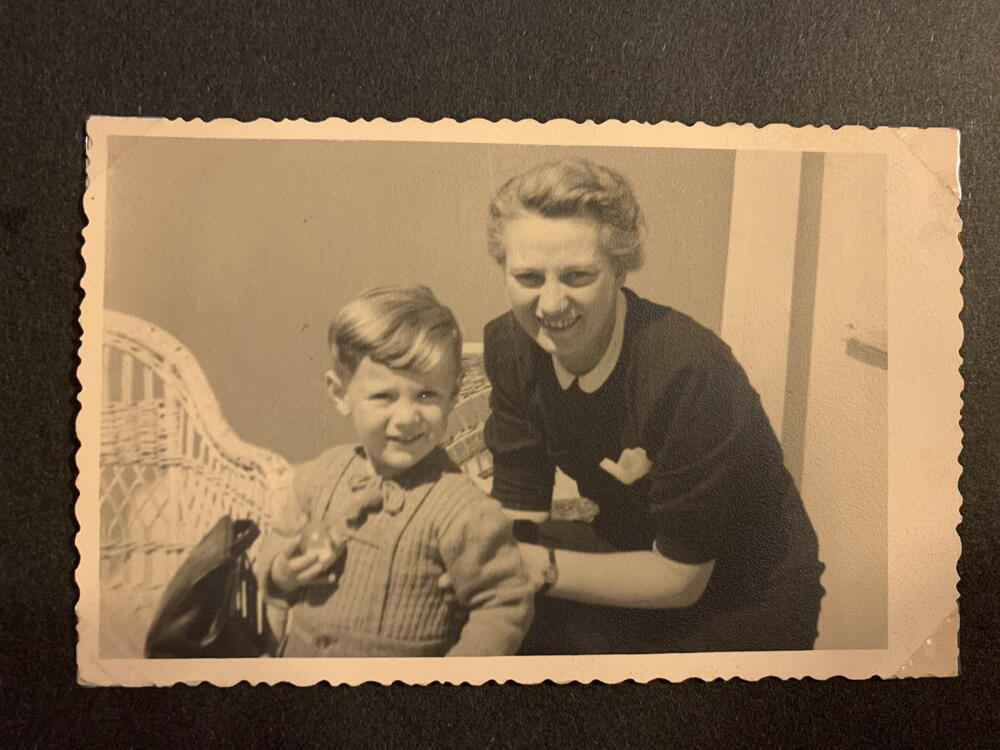
 The interviewee and his mother before fleeing to England
The interviewee and his mother before fleeing to England

1. Family Background & Father’s Journey

His story begins before his own memory has really developed. He tells us about his parents’ lives in Central Europe, shaped by changing politics and rising danger, which form the backdrop to his earliest years.

[My father] fought on all three fronts. He spent a winter -50 in Ukraine. He spent, winter at similar temperatures on the Italian front, high in the Alps. And he had a session on the Western Front in which he experienced the rolling barrages of artillery and more to the point, was gassed.

He describes his father’s life as a Jewish lawyer, First World War veteran, and social democrat who prosecuted Nazi violence in the Sudetenland. His mother, considered “Aryan” under Nazi racial laws, played a decisive role in securing the family’s escape. Their marriage was classified as “mixed,” and as the political situation deteriorated, his mother orchestrated his father’s departure to Britain while she and her young son remained behind for several months.


Father’s background, political role, and early Nazi persecution


[My father] rapidly became the attorney in Marienbad and a social democratic town councilor and most important of all he was the Schützenkönig. Now that is a big deal.

Mother’s actions and father’s escape journey


His parents’ story provides some historical context for his early life, but their experiences remain very different from his own. 

When the Nazi thing began to bubble up and, there was a lot of Nazi thuggery. He didn’t hesitate to prosecute the Nazis. Which they had meant. They had it in for him big time on every possible basis: Jew, social democrat, public prosecutor, jailing Nazis.


The Czech passport of the interviewee’s mother, issued in September 1938

2. Arrival in Britain: A Child’s Perspective

When he speaks about arriving in Britain, the tone shifts away from the political drama of his parents’ lives to the sensory world of a four‑year‑old. 

Off we went on the train to Holland. The next problem, because we didn’t have refugee status as my father did, was getting a boat. […] Eventually we got on a boat and I was seasick. It’s one of my very earliest memories. […]. We arrived in Harwich exactly on my 4th birthday.

He recalls specific details such as seasickness on the boat, a toy his mother bought for him, and the fact that he arrived on his fourth birthday. He remembers travelling to Britain, reuniting with his father and the first few weeks in Britain: 


Journey to Britain, arrival, and early impressions


His recollections highlight how a child can experience migration. His memory of the journey was shaped by everyday impressions rather than an understanding of displacement. 

So off we trundled to, London, where we joined up with my father and we were in digs in, Streatham. […] We had no money at all, and we had nothing that could be sold for money. We knew nobody and we didn’t speak English, and my father wasn’t allowed to work. […] So what we lived on was a thing called the Czechoslovak Trust Fund.


Czech refugee children in a V formation to celebrate VE Day in 1945. S is somewhere in the picture, which was taken by the boarding school’s headmaster.
Czech refugee children in a V formation to celebrate VE Day in 1945. The interviewee is somewhere in the picture, which was taken by the boarding school’s headmaster

3. Growing Up and Becoming Anglicised 

His early years in Britain were shaped by the reality of war just as much as by everyday experiences in a new country. Both certainly had an effect on him and his sense of identity. 

I’m at the primary school doing quite well and by now totally bilingual. I mean children just learn so quickly which is partly due to the fact that the vocabulary that you use is so limited. When an adult starts learning a foreign language they try to learn everything in the dictionary.

The air raids in York left a deep impression and he developed a fascination with aircraft. He describes learning English quickly and moving through different schools, including Czech boarding schools in Whitchurch, Shropshire and Malpas, Cheshire. He speaks of becoming “a country boy at heart,” exploring fields with farm dogs, and later preparing for the 11‑plus in Cheltenham. These years formed the foundation of his sense of belonging in Britain.

I became a complete country boy and more so at the end. Come 1945, the war ends, everybody goes back […] and there we are sitting in Hinton Hall by ourselves, my mother and I. I take over the farm dogs and my mother gives me sandwiches in the morning and I  just disappear with the dogs.


Air raids and wartime childhood


Language adaptation


Country boy at heart


Cheltenham and the 11plus


These experiences highlight how his everyday experiences in wartime Britain shaped him and rather than focusing on trauma, it unfolds in the ordinary processes of growing up. 


The interviewee and a friend in their air scouts uniform

4. A Life of Work, Travel, and Exploration

As he moves into adulthood, he talks a lot about his personal ambition and curiosity. Thanks to these character traits he took opportunities as they presented themselves and had the chance to explore the world.

I joined the air scouts. I was airplane mad. My one ambition in life was to fly a spitfire. And I spent all my time drawing airplanes.

He speaks about his early passion for aircraft, his involvement in the Air Scouts, and his academic path into chemical engineering at UCL with enthusiasm. His career took him across Europe, including long periods living in German‑speaking countries, where he felt entirely at ease. He also reflects on his father’s post‑war work in Berlin during the de‑Nazification process and the fates of other family members.

I kept up my German as best as I could. […] I went off hitchhiking round Germany and I think, and we were abroad for three weeks and I think we spent 50 pounds staying in the Jugendherberge obviously, and that kind of thing, living off Linsensuppe and Mettwurst or Bockwurst.

April 1941 with Czech friends at RAF Czech depot.
The interviewee’s uncle (front row, left) at the Czech Depot, possibly at RAF Cosford, April 1941


Fascination with aircraft and Air Scouts


Studying chemical engineering at UCL


Living in German‑speaking countries


Father’s post‑war work in Berlin


What happened to other family members


Five headshots of the interviewee as a boy

5. Reflections on Identity and Temperament

In the final part of the interview, we take a step back from the chronology of life and reflects on the deeper patterns like memory, identity, belonging, and temperament.

The is also the question of temperament. I’m one of those people who always wants to know what is around the next corner. […] It was always my ambition and I can remember writing an essay about the subject at the Czech boarding school about what you want to be when you grow up. And I wanted to be an explorer and so it turned out.

He speaks about how early experiences shaped his circumstances but not his identity, and how he never saw himself as defined by trauma. He reflects on memory, the challenges of moving frequently, and the difficulty of forming lasting friendships as a child. 


Memory


Defining himself


Moving around and relationships


Temperament


His reflections bring the interview full circle. It is clear that his life was shaped by early events, but ultimately defined by the choices, ambitions, and identity he forged for himself.

Subscribe to our Newsletter

Latest Publications