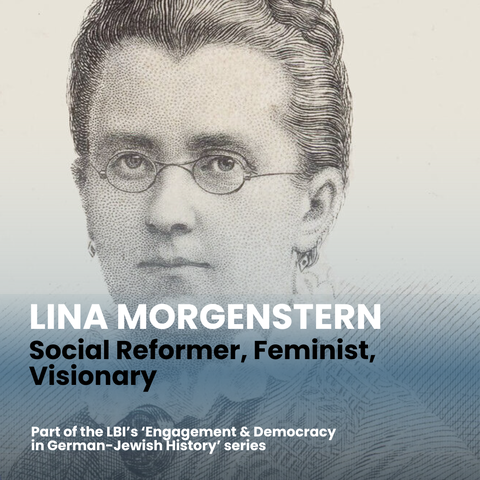
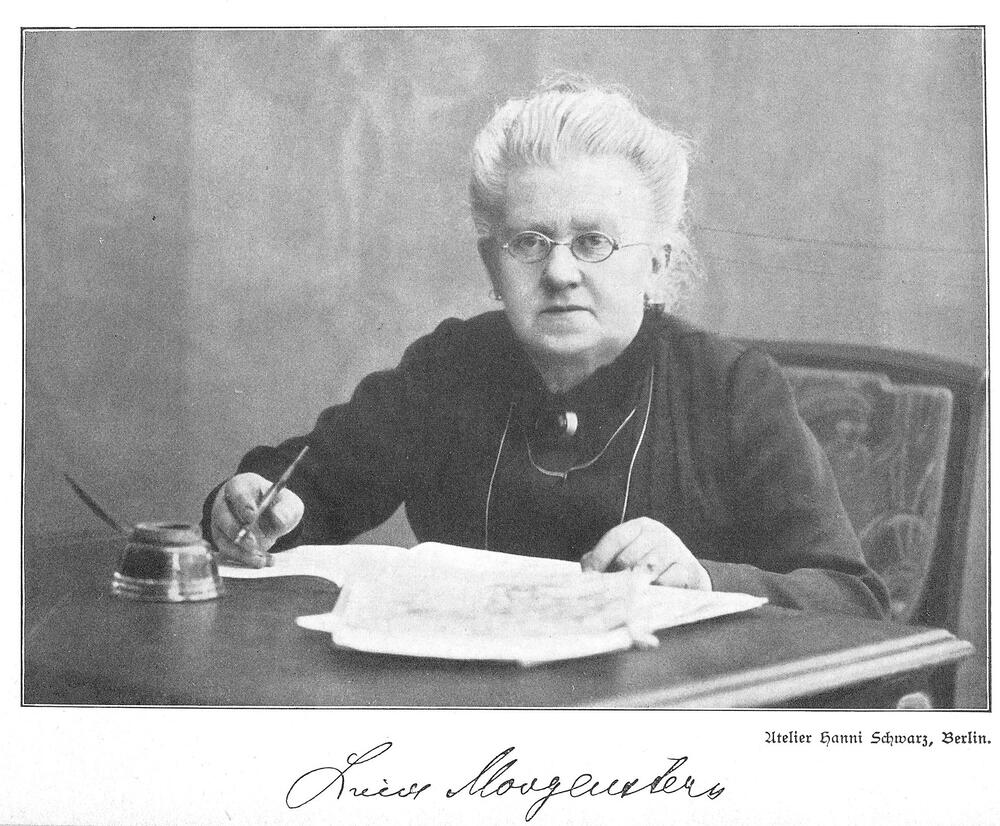
Lina Morgenstern was one of the most remarkable social reformers of the 19th century. In Berlin, she founded the first public kitchens, helping to feed the poor – but her work went far beyond that. She was a tireless advocate for women’s rights and for improving the lives of those on the margins of society. During wartime, she organised aid for wounded soldiers; in peacetime, she campaigned for peace itself. Morgenstern also wrote more than 30 books, using her voice to push for change in a society where women had little say in political or social affairs. She stood up for what she believed was good, just, and humane – and in doing so, she shaped a whole generation of reformers.
The Austrian author and filmmaker Gerhard J. Rekel has explored Morgenstern’s legacy in his recent biography Lina Morgenstern – The Story of a Rebel. Born in Graz in 1965, Rekel studied at the Vienna Film Academy and the Munich Screenwriting Workshop, and has worked as a screenwriter since 1990. His award-winning films and documentaries have appeared on Tatort, ARTE, and ZDF. As a writer, Rekel has published both fiction and non-fiction, including Monsieur Orient-Express, a biography of Georges Nagelmackers, which won the ITB BookAward in 2023. In this interview, he talks about the life and legacy of Lina Morgenstern – an extraordinary woman whose ideas continue to resonate today.
What led you to focus on Lina Morgenstern and ultimately write a book about her?
Walks. Long walks through Berlin. I kept seeing commemorative plaques on buildings mentioning Lina Morgenstern’s public kitchens. Eventually, I stopped and asked myself: who was this woman, really?
And? Who was she?
A phenomenon. I was completely blown away by the sheer scale of her work. Lina Morgenstern founded 17 public kitchens in Berlin that served hot meals to 10,000 people every day. During the Franco-Prussian War of 1870–71, when the state failed to help, she stepped in and organised food for 300,000 soldiers at Berlin’s railway stations. She even set up two emergency hospitals that treated 6,000 wounded soldiers – regardless of which side they fought on.
But she didn’t stop there. In the years that followed, she launched over 30 welfare initiatives – what we might call social start-ups today. She helped single mothers, troubled girls, women forced into prostitution, and others society had left behind. Somehow, she also found time to raise five children with her husband and write 32 books – many of which became bestsellers.
How did she manage all this at a time when women had hardly any rights?
That’s what fascinated me most. How did a woman from a Jewish family, up against antisemitism and the male-dominated power structures of her day, achieve so much? I was especially struck by her role in organising the first International Women’s Congress on German soil, at the Rotes Rathaus in Berlin. More than 1,700 participants came from around the world. It was a political earthquake.
And she did all this in an era when women weren’t even allowed to open a bank account or form an association. I wanted to understand her method, her strategy – what was her secret? That question drove my research. I visited ten archives, uncovered more than 700 sources, and gradually pieced together her story.
Lina Morgenstern didn’t just write down 2,700 recipes for her Universal Cookbook for the Healthy and Sick – she also came up with imaginative ‘recipes’ for tackling social problems. And many of those are still relevant today.
Where did Morgenstern come from? What sort of society and family background did she have?
Her mother came from a respected senator’s family in Breslau, and her father ran a successful antiques and furniture business. Like many middle-class families at the time, her parents wanted Lina to marry well and focus on family life. But from the age of sixteen, she was already questioning that path. Letters from that time show her restless spirit – she wanted more than domesticity. She wanted to make a difference, and that’s exactly what she did.
You des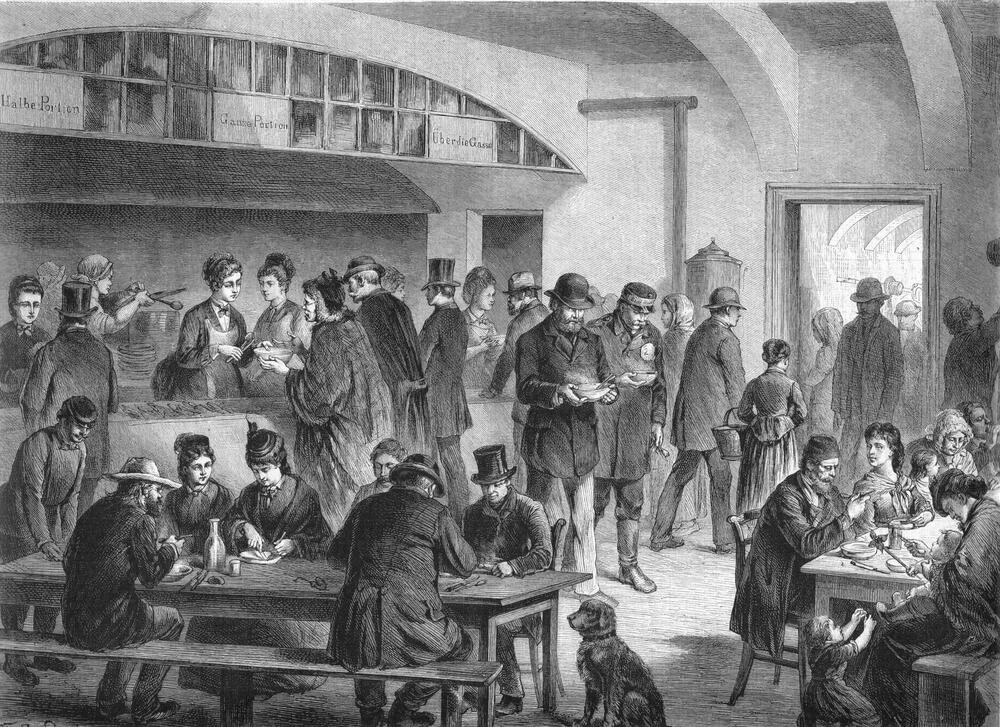 cribe in your book the influence of Lina Morgenstern’s mother on her daughter’s welfare work. What sort of woman was she?
Lina’s mother came from the educated bourgeoisie and wanted her daughter to become a respectable middle-class woman. Lina was sent to a so-called Higher Girls’ School, where she was taught cookery, needlework, and the finer points of social etiquette. But the school offered no qualification and no route to university.
Even as a child, Lina was unusually curious. She read books on medicine and astronomy, as well as the writings of Rahel Varnhagen and Bettina von Arnim – both early champions of political rights for women and Jews. But university was out of reach for a woman in 19th-century Germany. At seventeen, Lina fell into a deep depression. She felt trapped – by her parents, by society, by a future that seemed painfully limited.
But she didn’t give in. At eighteen, and against her parents’ wishes, she founded her first charitable association.
And how was her father in contrast?
Her father had more conventional ambitions. He wanted Lina to marry a wealthy businessman and settle down. But Lina had other ideas. She fell in love with a young Jewish revolutionary named Theodor. Her father strongly opposed the match, and Lina spent seven years fighting for the right to marry him.
In the end, she prevailed. She and Theodor lived a strikingly modern marriage – intellectually equal, mutually supportive, and quietly radical in its defiance of convention. They kept the true nature of their partnership a closely guarded secret.
Morgenstern met Abraham Geiger, the reform rabbi, early in life. What influence did he have on her?
Lina’s parents arranged for her to study with prominent Jewish scholars, and among them, Abraham Geiger stood out. He had a powerful impact on her thinking. Geiger was a leading figure in the Reform Judaism movement – he believed worship should be closer to everyday life, with prayers in the vernacular, music, and communal singing.
But more importantly for Lina, he encouraged ethical reflection and independent thought. He nurtured her intellectual curiosity and her sense of social responsibility. He even officiated at her wedding to Theodor.
Later, Geiger’s son Ludwig would write of her: ‘Even though she observed no ritual prescriptions and worked exclusively in general, non-Jewish associations, she remained a faithful daughter of her ancestral faith.’
At just 18, Lina Morgenstern founded the Pfennigverein – the Penny Association. What was this, and how was it funded?
For Lina’s 18th birthday, her father threw a grand party – but refused to let her invite her beloved Theodor. Instead, the room was full of wealthy businessmen and aristocrats. Lina, ever determined, used the occasion to launch her first charitable venture.
She proposed a simple but clever idea: each guest would pledge a monthly donation of just one penny, to fund school supplies and clothing for children from working-class families. Some guests hesitated – who would make sure the money reached the right people? Shouldn’t the donations go only to Jewish children?
Lina calmly and convincingly addressed their concerns. Then and there, she began collecting pledges, turning the party into a fundraiser. Most guests signed up for a ‘donation subscription’. That evening marked the beginning of the Pfennigverein, which would go on to support 16,000 children over the next thirty years. It was Lina’s first real success.
 At the time, kindergartens were banned by the Prussian state. Why was that, and how did Lina manage to found not just one, but eight?
In 1851, the conservative Prussian Minister of Culture, Karl Otto von Raumer, banned kindergartens. He accused them of harbouring ‘destructive tendencies in the fields of religion and politics’ – code for socialist influences. The real target was Friedrich Fröbel, the pioneering educator who had invented the concept of the Kindergarten as a place where young children could learn through play, creativity, and social interaction. His methods were seen by authorities as too modern, too egalitarian, and too threatening.
Lina was outraged and began a years-long campaign to overturn the ban. Working alongside the educationalist Friedrich Lette and other Fröbel supporters, she lobbied the ministry tirelessly. Eventually, the tide turned. By 1860, the government lifted the ban, and Lina was ready. She and her allies opened not just one, but eight kindergartens, offering a new model of early childhood education in Berlin.
What role did the concept of Zedaka play in her work?
Lina understood how to harness Zedaka – the Jewish principle of charity – not just as a moral duty, but as a powerful social tool. She appealed to the religious obligation to ‘not close one’s heart and hand to the poor’, and in doing so, recruited a dedicated group of mainly Jewish, middle-class women to volunteer in her initiatives, especially the public kitchens.
These women helped cook and distribute thousands of meals, making it possible to run 17 kitchens without state support. But Lina’s work was never confined to the Jewish community. She was guided by Zedaka, but her compassion and activism extended to people of all backgrounds and faiths.
Did Lina Morgenstern also become politically active?
In her youth, she believed that ‘in times of need, something must be done immediately – there’s always time for political visions later’. That pragmatic approach stayed with her, but it evolved.
In mid-life, she began thinking more systematically about change. She wanted to shape not just society’s response to crisis, but its future. As part of that shift, she founded a successful weekly newspaper – a platform for advocacy and reform.
Did all of Lina Morgenstern’s ventures succeed?
No. Twice she went bankrupt. Her life was anything but a smooth ascent – more a series of dramatic swings between failure and triumph, ridicule and acclaim. But in the end, the recognition came. She was honoured across Europe and in America and is remembered today as one of the foremost social reformers of her time and a foundational figure in both the women’s movement and the early peace movement. On her 70th birthday, the Hebrew newspaper HaZefira described her as ‘the most famous woman in Berlin’. In the German capital, she was ranked among the five most significant public personalities of the era.
Do you see parallels with the present day?
Absolutely. Many of the tensions Lina grappled with still shape our world: the persistence of gender inequality, the divide between nationalists and cosmopolitans, the toxic effects of antisemitism, the growing gulf between rich and poor, and the ongoing fight over what constitutes the ‘good’. Lina refused to retreat into private comfort or live off her privileges. Instead, she devoted her life to what she saw as the good – understood, in the spirit of Immanuel Kant, as a will guided by reason, not personal gain. And the truth is: most of her ventures succeeded. Hers is a story that gives courage.
Text: Lutz Vössing
This article is part of the series Civil Engagement and Democracy in German History: Jewish Experiences and Perspectives, first published in German as Engagement & Demokratie in der jüdisch-deutschen Geschichte by the Freunde und Förderer des Leo Baeck Instituts. You can read the original German article here: https://fuf-leobaeck.de/2025/05/lina-morgenstern-sozialreformerin-femin…