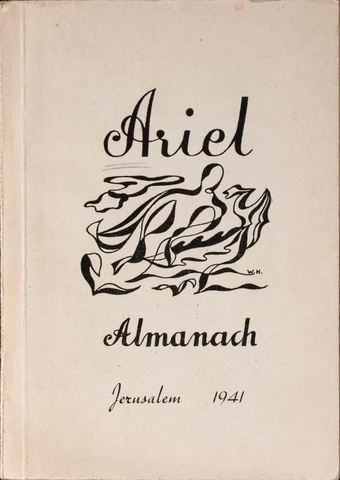
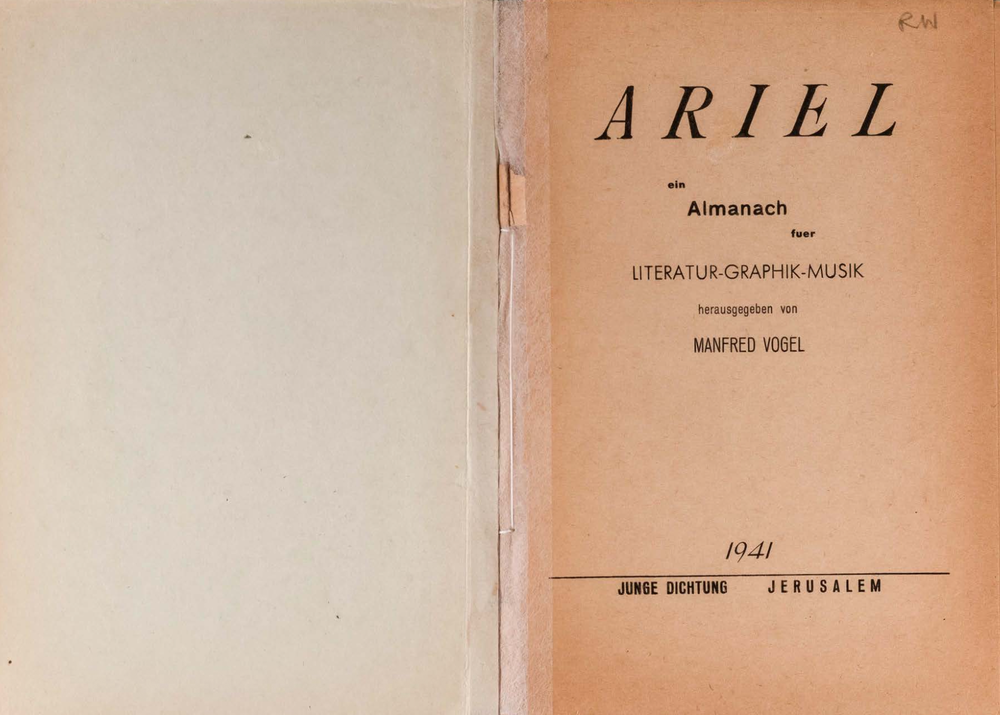
In 1941, when the Second World War engulfed Europe, a group of German-Jewish refugees in Jerusalem published an ambitious almanac: Ariel: Ein Almanach für Literatur-Graphik-Musik. Edited by a young émigré journalist Manfred Vogel (1923–1983) and issued by Junge Dichtung press, the volume brought together poetry, visual art, and music, capturing a German-Jewish culture in transit — displaced from its European cradle, but not yet integrated into the new, Hebrew-speaking society.
Following the Nazi rise to power, thousands of German Jews sought refuge abroad. For many, Mandatory Palestine seemed both a practical destination and a symbol of upcoming Jewish socio-political revival. That said, emigration from the Reich was a labyrinth of bureaucratic obstacles, costly permits, and ever-changing international regulations on refugees, complicated by increasingly restrictive British policies on Jewish immigration to the Middle East. Yet still, by the outbreak of the Second World War, roughly 60,000 Jews from the Reich had reached Mandatory Palestine and begun (re)building their social and artistic lives.
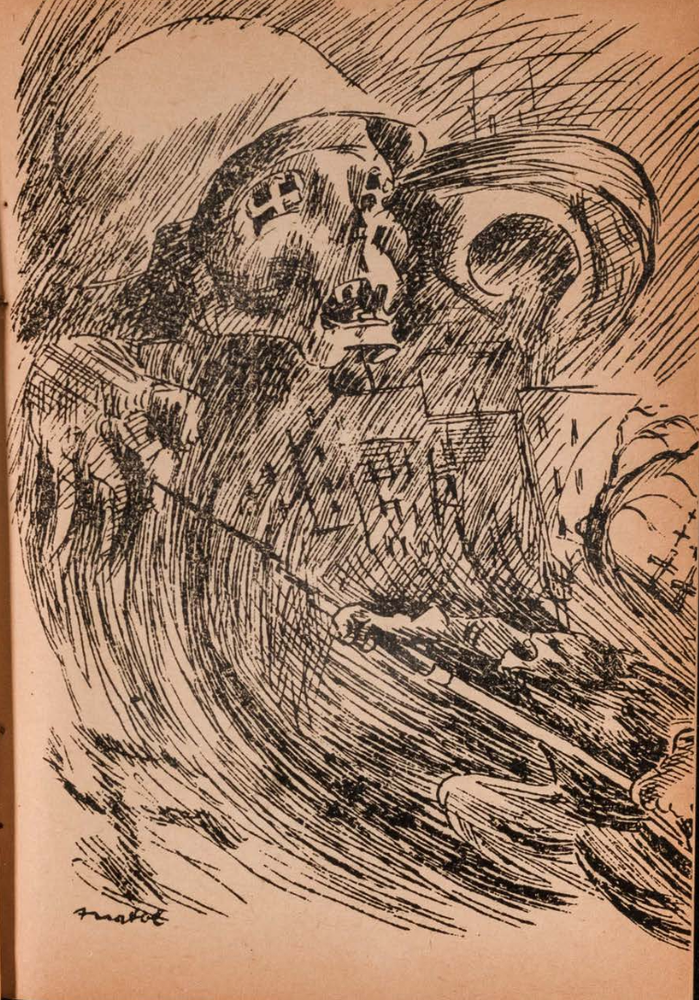
An unexpected fault line, though, was linguistic. Hebrew was championed by the Yishuv as the language of national renewal, while German occupied a far more ambiguous position, at once a treasured intellectual inheritance and the language of the notorious antisemitic regime. As a result, although most German-Jewish émigrés arrived with little to no Hebrew, their efforts to sustain a local German-language press met strong resistance. Repeated attempts to establish German-language periodicals foundered in a society that wanted to “keep Hebrew [as] the sole language of written communication” (von der Osten-Sacken and Smedley, 2002, p. 74e).
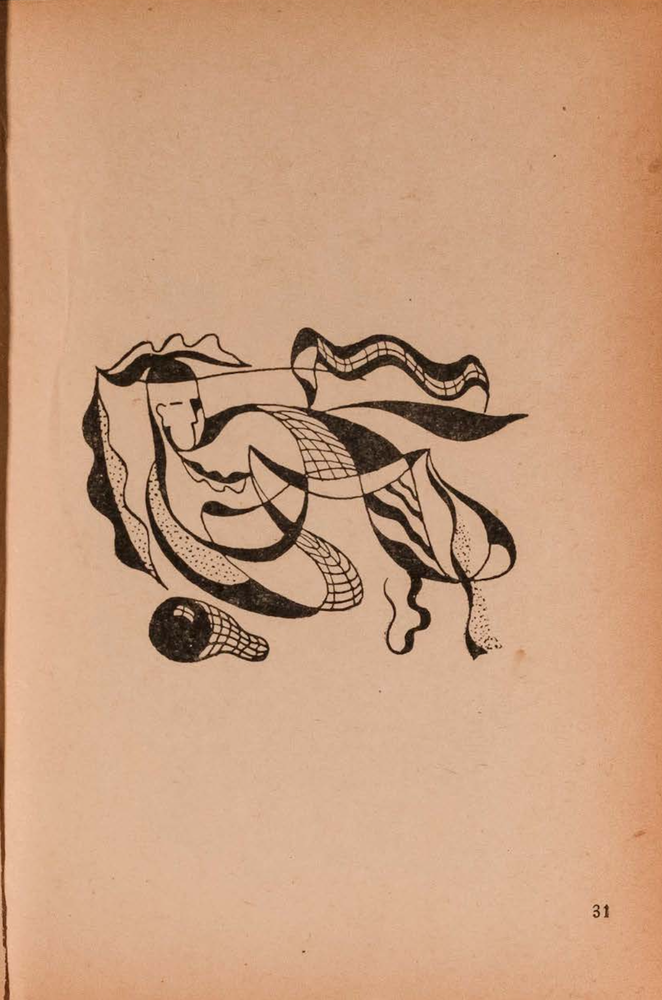
With that in mind, the emergence of Ariel seems all the more defiant. Stubbornly German in its linguistic and cultural sensibilities and ambitious in its interdisciplinary scope, the almanac pushed back against the suffocating permanence of exile. It insisted that displacement must not mean cultural severance and reminded the German-Jewish refugees that their language could still bridge the divide between the “two German literatures: at home and abroad” (Lengyel, 1938, p. 5). Moreover, Ariel’s artists’ relationship to Eretz Israel itself was often ambivalent: many of them regarded themselves as temporary refugees, reluctant expatriates awaiting a return home, to Europe, rather than pioneers of Jewish nationhood. For some, the belief that exile was only provisional proved prophetic. Author Arnold Zweig (1887–1968), for example, returned to East Germany in 1948, where he later became a member of parliament; Vogel moved to Vienna in 1952; Wolfgang “Wolf” Hildesheimer (1916–1991), having worked as a translator at the Nuremberg Trials, settled in Switzerland after 1946.
This sense of being suspended between worlds — German- and Hebrew-speaking; European and that of Mandatory Palestine; one engulfed by war and one animated by hopes for renewal — permeates the works collected in Ariel and is especially evident in the volume’s poetry. Though written by different authors, the poems circle around the same liminal space between loss and hope and reach toward a remembered Germany, or visionary Eretz Israel, or maybe a purely imagined, lost and/or not-yet-found Heimat that exist beyond geography altogether.
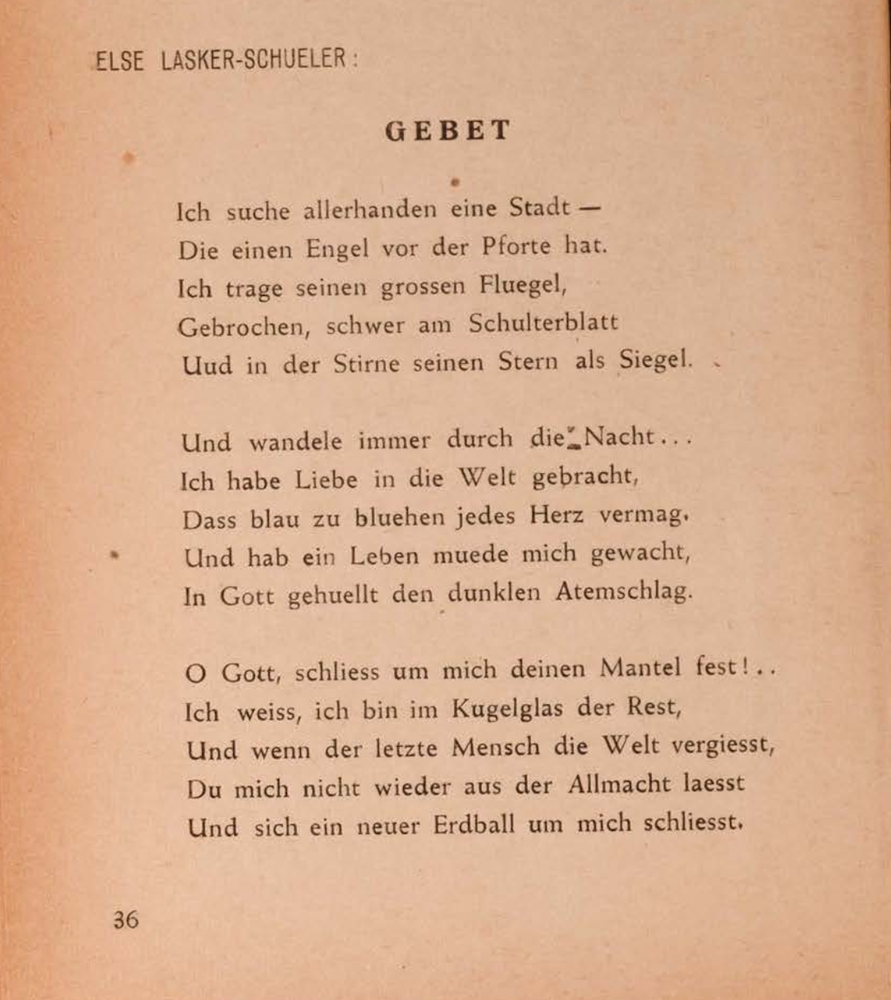
ELSE LASKER-SCHUELER
PRAYER
I seek, among all places, a city —
one that has an angel at its gate.
I bear his mighty wing,
broken, heavy upon my shoulder blade,
[Uud] and on my brow his star as a seal.
And I wander ever through the night…
I have brought love into the world,
so that every heart may blossom blue,
and through a lifetime I have kept my weary vigil,
wrapped in God, through each dark breath.
O God, draw your mantle around me!…
I know that in the glass sphere I am the remnant,
and when the last human being pours the world away,
you will not let me out of your omnipotence,
and a new earth will close itself around me.
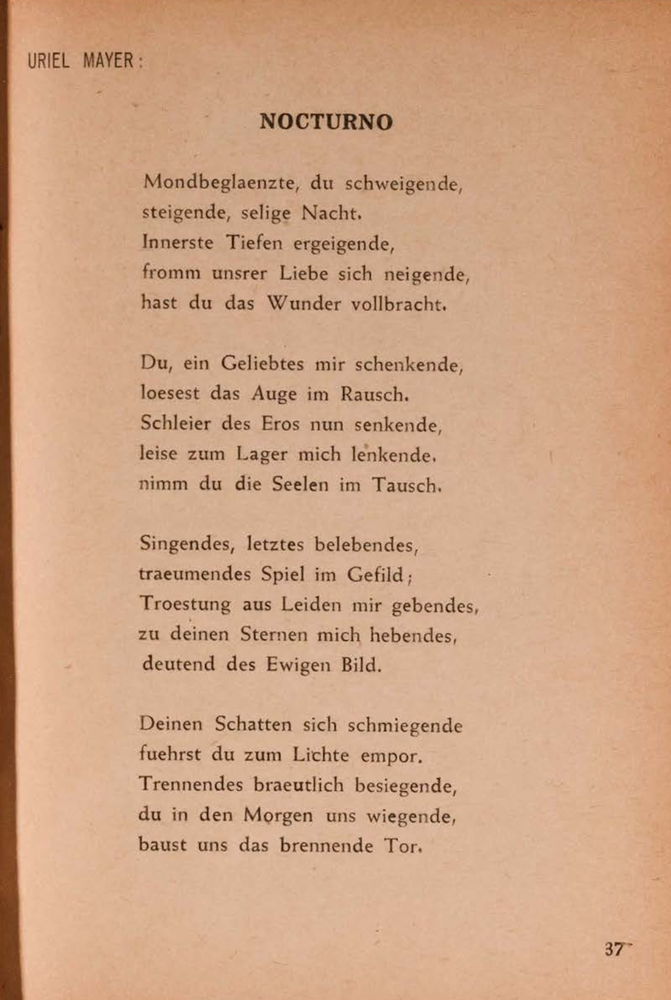
URIEL MAYER
NOCTURNO
Moon-lit, silent,
rising, blessed night.
Sounding the innermost depths,
devoutly bending toward our love,
you have wrought the miracle.
You who grant me a beloved,
dissolve the eye in ecstasy.
Now lowering the veil of Eros,
gently guiding me to the bed,
receive our souls in exchange.
Singing, giving final life,
dreaming play upon the meadow;
offering me comfort from suffering,
lifting me toward your stars,
revealing the image of the Eternal.
Clinging to your shadow,
you lead upward into the light.
Overcoming all that would divide, as a bride,
you rock us into the morning,
and build for us the burning gate.
The roster of Ariel’s contributors included many prominent German-speaking artists from Prague, Berlin, and Vienna. Among them were Max Brod (1884–1968), an author and Franz Kafka’s literary executor; Else Lasker‑Schüler (1869–1945), the celebrated German-Jewish poet whose epitaph was later written by Vogel; the acclaimed Israeli author Lea Goldberg (1911–1970), whose novel And This Is the Light (Hebrew: והוא האור) was the first modern Hebrew novel written by a woman; a pioneering Israeli filmmaker Margot Klausner (1905–1975); and many more.
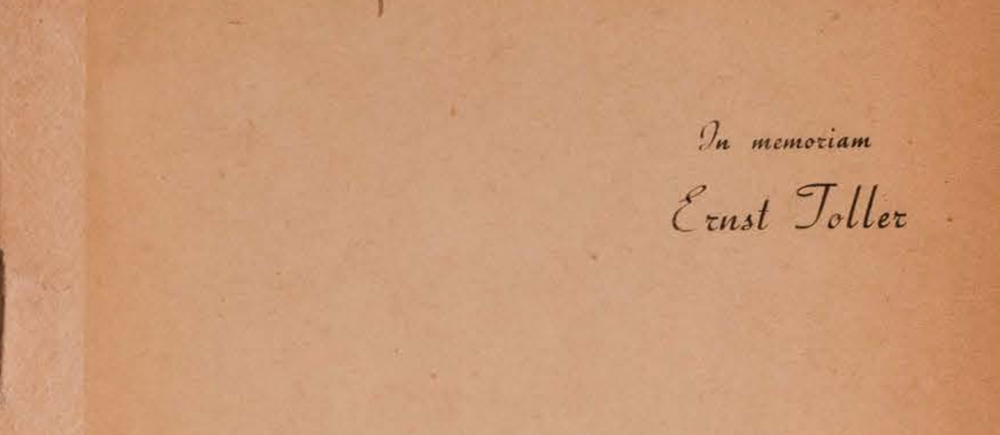
Ernst Toller (1893–1939) receives an honorary mention; it is to his memory that the volume was dedicated. One of the most celebrated German-Jewish playwrights of the Weimar Republic and an early critic of National Socialism, Toller became a particular target of the Nazi regime after its rise to power. His books were publicly burned, and he was driven into exile, where, after years of displacement and tireless efforts to warn international audiences about Hitler’s antisemitism, he took his own life in 1939. Two years later, in Jerusalem, the artists of Ariel, many of whom knew Toller personally, mourned both a dear friend and the homeland that had nurtured them before declaring them unwanted.
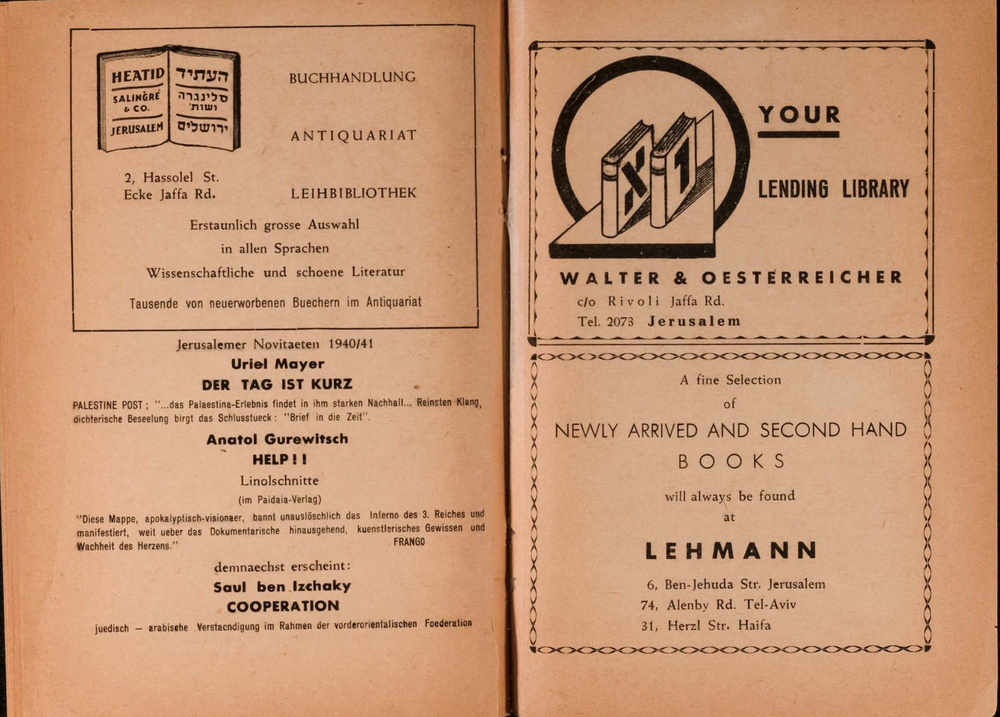
On the evidence we currently have, this volume stands as the first and only edition of the almanac ever produced. Yet, its final pages suggest a project that imagined a future for itself: they promote other titles from Junge Dichtung, including Vogel’s Herz‑Flöten‑Solo and Spiegel‑Sterne, and announce forthcoming works by Saul ben Izchaku, Walter Levy, and others. They also list lending libraries, bookshops, and theatrical listings, sketching a map of the tightly knit German‑speaking cultural milieu of Mandatory Palestine.
Bibliography:
Feinberg, Anat. “Abiding in a Haunted Land: The Issue of Heimat in Contemporary German-Jewish Writing.” New German Critique, no. 70 (1997): 161–81. https://doi.org/10.2307/488503.
Jacobs, Steven Leonard. “German-Jewish Identity: Problematic Then, Problematic Now.” In Who Is A Jew?: Reflections on History, Religion, and Culture, edited by Leonard J. Greenspoon. Purdue University Press, 2014. https://doi.org/10.2307/j.ctt6wq61q.19.
Lengyel, Emil. “German Émigré Literature.” Books Abroad 12, no. 1 (1938): 5–8. https://doi.org/10.2307/40079110.
Leo Baeck Institute. “GERMAN EXILE LITERATURE.” Leo Baeck Institute Library. https://www.lbi.org/de/collections/rare-books/exile-literature/.
Morris, Joel. “On the Borderlands of Loneliness and Community in Twentieth Century German-Jewish Literature.” Journal of Modern Literature 34, no. 3 (2011): 203–6. https://doi.org/10.2979/jmodelite.34.3.203.
Vogel, Manfred (ed.) Ariel: Ein Almanach für Literatur-Graphik-Musik. (Jerusalem: Junge Dichtung, 1941).
von der Osten-Sacken, Thomas, and Beatrice Smedley. “Tribulations of a World Zionist Newspaper: The Rise and Fall of the ‘Jüdische Welt-Rundschau.’” Kesher / קשר, no. 31, 2002, pp. 72e–81e. JSTOR, http://www.jstor.org/stable/23918875. Accessed 2 June 2026.