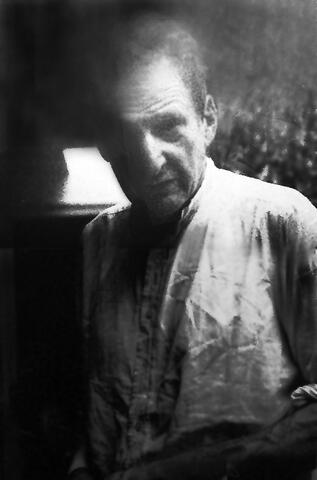
Today marks the anniversary of the birth of Lucian Freud (1922–2011), the British painter and grandson of Sigmund Freud who fundamentally reshaped the trajectory of 20th-century figurative art. Born in Berlin, where his architect father had set up his practice, Freud emerged as one of the foremost portraitists of the modern era, wielding hyperrealistic representation as a form of psychological and phenomenological inquiry into the human condition.
Fleeing Nazi Germany in 1933, Freud’s early trajectory was shaped by German Expressionism and Surrealism before his decisive turn toward portraiture by the late 1940s. What distinguished his approach was his unflinching commitment to depicting the body – flesh, aging, vulnerability, psychological depth – not as an idealized subject but as a terrain of profound human authenticity. His intensive study of the human figure, pursued almost exclusively through direct observation and engagement with his subjects, constituted a principled resistance to abstraction during its dominance in mid-century modernism.
Freud’s legacy extends far beyond his technical mastery of oil paint. His thick impasto technique, his psychological penetration, and his refusal to aestheticize the human form established a new paradigm for figurative representation. His influence can be traced through subsequent generations of artists who have embraced the raw complexity of embodied human experience – from Jenny Saville to Luc Tuymans – demonstrating the enduring significance of his artistic vision.
Honoured with the Order of Merit in 1993, Freud’s body of work stands as testament to the continued relevance of humanistic inquiry within contemporary art.