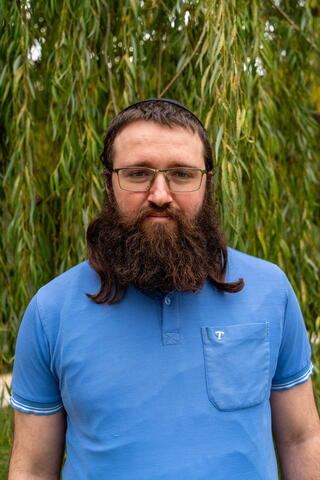
The latest feature in the Leo Baeck Institute’s Meet the Fellows series introduces Ahuvia Goren. His PhD research on early modern Jewish Italian thought explored doubt and scepticism among Italian-Jewish thinkers in light of new scientific ideas, humanist scholarship and religious controversies.
Can you briefly describe your doctoral research project for a non-specialist audience? What inspired you to pursue this topic?
My doctoral research examined uncertainty, unbelief and skepticism among early modern Jews in Italy, including many Ashkenazim, situating Jewish thinkers within the broader intellectual and cultural transformations of early modern Europe. What may seem like universal human experiences, uncertainty and the search for proof, actually take very different forms depending on historical context. I explored the early modern ways in which people came to question how different kinds of knowledge, news, religious beliefs, and philosophical ideas, were formed and verified. I was especially interested in how developments such as the expansion of postal networks, the circulation of new scientific ideas, humanist scholarship, and religious controversies changed the way people thought about knowledge and belief. My work traces how Jewish intellectuals engaged with these cultural shifts while also drawing on internal Jewish traditions. What inspired me to pursue this topic was a fascination with the relationship between science, religion, and culture, and with the realization that many of the conceptual categories we take for granted today could be rethought through their histories.
How does your current work engage with wider themes or ongoing debates in your academic field?
My current work engages with debates about the relationship between science, religion, and secularism in early modern and modern Europe, with German-Jewish culture now serving as a central focus of my research. Following scholars who caution against treating “science” and “religion” as fixed or opposing categories (Harrison, Millbank), I examine how these concepts were historically shaped through intellectual, theological, and cultural interactions. I am particularly interested in how ideas such as atomism, Cartesian philosophy, and medical knowledge circulated across religious and cultural boundaries, including within Jewish thought.
In the context of German-Jewish history, considerable scholarship has explored the conflicts between rabbis, communal leaders, and proponents of the Haskalah. My current work contributes to these discussions through newly examined archival sources, especially from the early eighteenth century, which reveal Jewish readings of Descartes and their influence on contemporary ethical literature. I also pay closer attention to the role of language drawn from natural philosophy within eighteenth-century debates about the Talmud, rabbinic authority, and religious knowledge. My research shows that, in the Haskalah debates, as in many others, the cultural influence of science operates less through scientific discoveries or theories themselves than through the metaphors, narratives, and images associated with them. These representations shaped discussions about truth, authority, belief, and modernity in the past, and many continue to influence cultural and political debates today.
In what ways did your studies or experiences prepare you for your doctoral research and the work you are doing now?
My studies and experiences prepared me for my research in several complementary ways. Academically, my training combined history of science and intellectual history, which gave me the methodological tools to work across disciplinary boundaries and to connect Jewish sources with broader European developments. My work also required engagement with different languages and archival materials, helping me develop the philological and historical skills necessary for studying early modern intellectual culture.
Beyond formal academic training, my background moving between yeshivot, the humanities, and various educational frameworks shaped many of the questions that continue to guide my research. It made me especially sensitive to the ways intellectual traditions, both traditional and scholarly, form shared assumptions, categories, and modes of authority, in ways that are not always fully visible to those within them. This experience encouraged my interest in skepticism, conceptual change, and the historical construction of overarching narratives of modernity.
In addition, my dissertation, conducted as part of the ERC project Jewish Translation and Cultural Transfer in Early Modern Europe (JEWTACT), and my postdoctoral work at the Polonsky Academy at the Van Leer Jerusalem Institute have involved sustained engagement with archival research, interdisciplinary scholarship, and international academic conversations. Together, these experiences prepared me to pursue the big comparative questions that define my current research.
What have been the most rewarding and most challenging aspects of your academic journey so far?
One of the most rewarding aspects of my academic journey has been the opportunity to uncover overlooked archival materials and connect them to larger intellectual and cultural questions. I find it especially meaningful when many small textual discoveries illuminate broader historical patterns or challenge assumptions about familiar concepts. I have also deeply valued the chance to participate in international scholarly conversations and to engage with researchers from different disciplines and intellectual traditions.
Beyond the difficulty of balancing research and everyday life during the difficult years Israel has experienced recently and amid deeply troubling events, the main challenge has been maintaining a balance between detailed archival work and the broad conceptual questions that motivate my research, which are also informed by contemporary debates and public discourse.
How has the LBI fellowship influenced your research and academic progress?
The LBI fellowship provided an excellent opportunity to engage with scholars working on topics that were not entirely disconnected from my own, but approached from very different disciplinary perspectives. One of the most valuable aspects of the program was the methodological discussions that emerged through close readings of one another’s work. I remember the feedback I received on the materials I presented in the workshops as particularly helpful and intellectually stimulating. The fellowship also created a strong sense of collegiality and shared experience, especially around the challenges of completing the final stages of the doctorate. That atmosphere of mutual support, alongside the interdisciplinary exchange, was a truly valuable and helpful gift.
If you could share one insight or piece of advice with future researchers interested in German-Jewish studies, what would it be?
German-Jewish studies is an exceptionally rich field because its sources and themes are connected to so many broader intellectual, religious, and cultural contexts. One piece of advice I would offer future researchers is to develop a working method that helps preserve small details and unexpected connections over long periods of reading and research. Personally, I find working with index cards extremely useful, and I often recommend trying it. It may seem somewhat old-fashioned, but alongside broad reading it encourages a more attentive and cumulative form of note-taking that preserves details which can later become surprisingly important. Of course, no single method works for everyone, but I think this style of slow and associative reading has largely gone out of fashion too quickly, and I continue to find it remarkably valuable for archival and intellectual-historical work.
Is there a book, artwork, or historical figure that has particularly inspired you in your studies?
I am deeply inspired by many of the figures I study, thinkers such as Simone Luzzatto, Moshe Gentili, and Yehudah Gonzaga. They mastered the new sciences and intellectual developments of their time while also advocating for their marginalized Jewish communities. What I find especially compelling is their ability to combine wide intellectual horizons with moral seriousness: they could engage critically with internal social and ethical problems while writing with breadth, sharpness, and often a subtle sense of humor. Their works reminds me that the active cultivation of virtues, intellectual curiosity, and cultural self-reflection can coexist in powerful and creative ways.