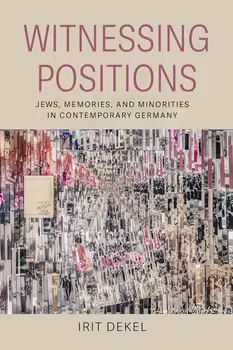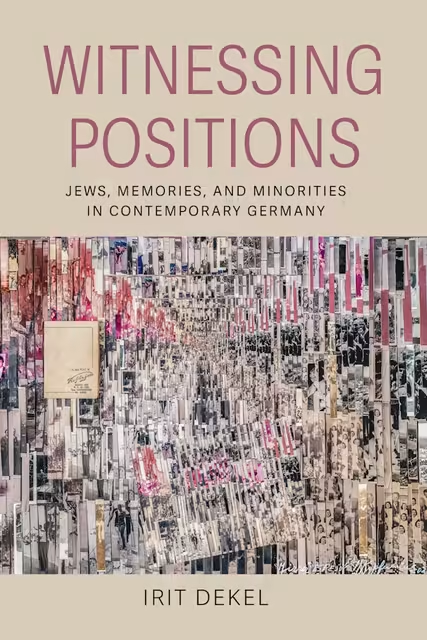
In Germany, public debates about Holocaust memory, antisemitism, and migration often focus on minorities while leaving their voices, perspectives, and social presence at the margins. In defining the terms of inclusion, majority society assigns minorities particular social roles.
In Witnessing Positions, Irit Dekel asks what happens when minorities respond to and transform these roles through witnessing. The book redefines the concept of the witness not only as someone who testifies to past events, but as an individual or group that accounts for present social realities. Dekel demonstrates how minorities forge their social presence through diverse acts of witnessing directed toward their own communities, other minorities, and majority society alike. By extending the concept of witness and witnessing beyond the centrality of Holocaust-survivor testimony, Witnessing Positions makes a vital contribution to our understanding of contemporary German memory cultures, showing how public discussions about memory become dynamic arenas in which minority subjects are constituted and belonging to majority society negotiated and contested.
A two-part study, Witnessing Positions analyzes legislation, public media, commemorative events and sites, museum exhibitions, and memory activism over the last two decades, offering a novel framework to understand public appearance and social agency in changing democratic societies.
Irit Dekel is Associate Professor of Germanic Studies and the Borns Jewish Studies Program and director of the Olamot Center at Indiana University. She is author of Mediation at the Holocaust Memorial in Berlin.
This book beautifully demonstrates the complex and nuanced way in which different minorities are positioned in relation to each other and how their positionality is shaped through different practices of witnessing of injustice from various majority and minority positions in Germany. It is an amazingly well written work that brings together striking examples from many registers that vary from opera pieces to government statistics, museum exhibits to graffiti written on walls. It is absolutely eye opening, fresh, and enlightening about how minority-majority relationships work in 21st century Germany.
- Esra Özyürek, author of Being German, Becoming Muslim: Race, Religion, and Conversion in the New Europe