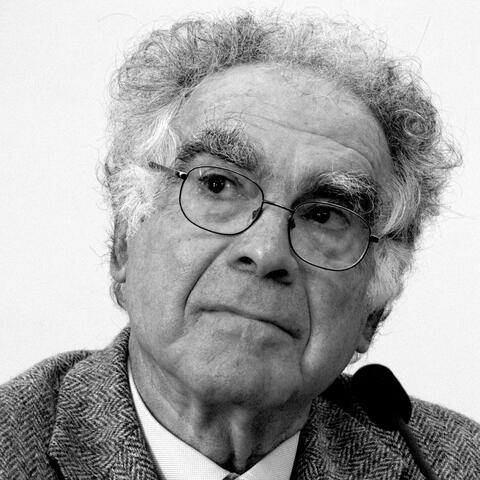
The Leo Baeck Institute London is saddened to learn of the passing of Carlo Ginzburg, the renowned Italian historian and champion of ‘microhistorical’ methodologies, who delivered the Gerhard Riegner Memorial Lecture in LBI London’s 2004/05 lecture series in partnership with the Wiener Holocaust Library and the Centre for German-Jewish Studies at Sussex University.
Born into a distinguished Jewish family in Turin in 1939, Carlo was the son of the literary scholar and anti-fascist Leone Ginzburg and the acclaimed author Natalia Ginzburg née Levi. Persecuted by the Fascist regime on political and racial grounds, the family was sent into internal exile in southern Italy in 1940. They were able to return to Rome in 1943, where Leone Ginzburg died in 1944 after being tortured by the SS.
Carlo Ginzburg’s academic career took him from the Scuola Normale of Pisa to the Warburg Institute in London and to the universities of Bologna, Harvard, Yale, California, and Princeton. Many of his books were devoted to witchcraft and peasant folk beliefs in early modern Europe, which he explored by focusing on individual lives or events to reveal broader social, cultural, and historical patterns. He acknowledged the French medieval historian Marc Bloch, also executed by the Nazis in 1944, as his greatest influence.
In his work, Ginzburg often examined Christian attitudes toward socially marginalised groups such as heretics, witches, and Jews. In later years, he also wrote about Christianity’s ambivalent relationship with Judaism and reflected on how the persecution he experienced as a child influenced his research. His attention to particular lives and minority experiences has had a lasting impact on Jewish historiography.
Image: Wiki