Earlier this year, Tatiana Martin joined LBI London as an intern, bringing a strong background in Modern and Medieval Languages and a deep interest in historical memory in twentieth-century Europe. During her placement, she interviewed a guest for our podcast, carried out translation and digital media work, reviewed past lectures for YouTube, updated the Year Book pages on the website, and conducted provenance research using DigiBaeck.
In this short Q&A, Tatiana reflects on what drew her to the institute, how her internship has shaped her academic and career plans, and what she would tell prospective interns. Her time at LBI London has reinforced her decision to pursue postgraduate study in European History, with a module in European Jewish History, and to continue exploring questions of historical memory and collective identity.
Please could you introduce yourself and outline your academic background?
My name is Tatiana, and I graduated last summer with a degree in Modern and Medieval Languages from the University of Cambridge. My main languages were Spanish and German, although I also studied Portuguese and Ukrainian.
I have a particular interest in historical memory and national myth-making in twentieth-century Europe, which led me to write my Year Abroad Project on sites of memory in Spain following the Civil War and Francoist dictatorship, while my final dissertation analysed the theme of death and sacrifice in National Socialist mythology.
I will begin a Master’s in European History later this year, through which I hope to further explore these interests from different national and transnational perspectives.
What led you to apply for an internship with the LBI?
I wanted to learn more about the work of a research institute, since I am curious about possible careers in academia. I was also drawn to the focus of the LBI; although I had engaged with German-Jewish history in my undergraduate studies, this was mostly within the context of the Holocaust, and I was keen to expand my knowledge beyond the twentieth century.
As part of your internship, you interviewed a guest for our podcast. How did you approach the interview, and what were your key takeaways from the discussion?
Oral histories are so key to the study of historical memory, so participating in this interview was a particularly exciting opportunity for me from an academic point of view, and I was looking forward to learning how such interviews are conducted in a research context.
Sitting in the home of someone I had never met before, listening as they shared stories and photographs from their life and the lives of their close family members, was a unique and humbling experience, and above all I felt privileged to have been included in this discussion. To me, it highlighted the complex relationship between memory and identity, as well as the challenge of conducting academic research in this field, where the subject matter is so personal, sensitive, and nuanced.
You undertook various practical tasks, including translation and preparing digital media. How did this work inform your understanding of how historical research is communicated to the public?
It is a shameful reality that, in the era of artificial intelligence, the Humanities often find themselves having to “justify” their importance. When communicating historical research to the public, and especially when trying to reach a wider audience, there is often the question of relevance: Why should we, as a wider society, care about this? Why does this matter to us now? In fact, the study of history continually refreshes itself. One of my tasks was to review some of the past lectures so that visual material could be added on YouTube. It was interesting to reflect on the themes of decade-old lectures from present-day perspectives; many of the discussions have developed completely new dimensions over the past few years and are arguably more “relevant” than ever before.
Whilst auditing our website and inventorying the library, did any specific resources or aspects of the institute’s work stand out to you?
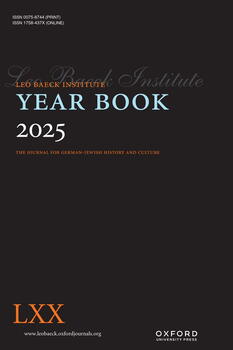
One of my tasks was to update the Year Book pages on the website. I was fascinated by how scholarly writing on Jewish history has changed over the past 70 years. The first LBI Year Book was published just over 10 years after the end of the Second World War, with contributions from authors who had personally experienced the traumatic events that they were now writing about in an academic context. From this perspective, the early Year Books are not only incredibly valuable as a scholarly resource, but also as lieux de memoire, sites of memory. The selection of topics that are discussed in each edition is significant in itself, as well as the thematic variations (and consistencies) over the years and decades.
I must also mention DigiBaeck, the digital collection of the LBI, which I consulted while conducting some provenance research. It’s an incredible resource, with photographs, memoirs, correspondence, documents, audio recordings, and more – I can absolutely recommend allowing yourself to fall down an archival rabbit hole.
You intend to begin postgraduate studies later this year. How has your time at a research institute influenced your academic and career plans?
My time at the LBI certainly enhanced my interest in historical memory and collective identity, and I am looking forward to engaging with these topics further through my Master’s. I also plan to take a module in European Jewish History as a part of my degree, so that I can build on the knowledge that I gained through my internship.
Working with the team day-to-day and chatting with the researchers also provided me with a fresh perspective on careers in academia, and now I am even more determined to pursue my passions and interests and continue learning for as long as possible.
Finally, what advice would you offer to prospective interns considering a placement at the institute?
If you are interested in any aspect of the LBI, I would not hesitate to send in your application. As well as engaging with stimulating research and contributing to exciting initiatives, you will also be welcomed into an incredibly friendly team and have the unique opportunity to work in a lovely corner of the Senate House with unbeatable views of Bloomsbury. I am certain that it will be a valuable experience for you as well!
Tatiana will begin her Master’s in European History later this year. We are grateful for her contribution to LBI London’s research, communications and digital work, and we look forward to seeing how her interests in historical memory, oral history and Jewish history develop in her postgraduate studies.
Thank you, Tatiana, for your thoughtful reflections and for your dedicated work during your internship.