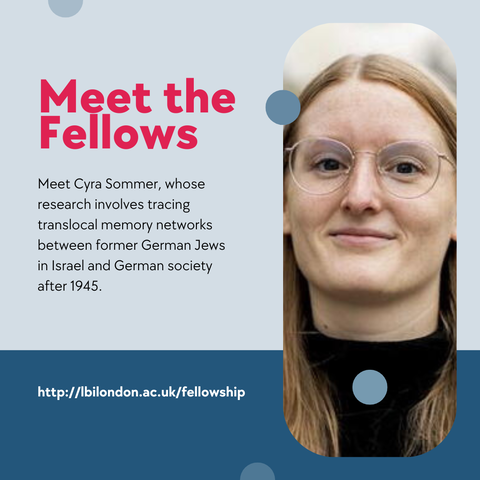
Through our Meet the Fellows series, we introduce the researchers in our fellowship programme and the questions that shape their work. In this interview we speak with Cyra Sommer whose doctoral project traces “translocal memory networks” linking former German Jews in Israel with German society after 1945, focusing on contacts and collaborations in what later came to be known as memory culture. Her research explores how German-Jewish history became an object of negotiation between individuals and across borders, and how these relationships evolved from the early 1960s to the 1990s
Can you briefly describe your doctoral research project for a non-specialist audience?
My dissertation project explores the history of relationships between former German Jews in Israel and German society after 1945. I focus on one specific aspect of these relationships: contacts and collaborations in what later became known as “memory culture” or remembrance culture.
In my research, I trace – as I call them for now – ‘translocal memory networks’ that emerged through a wide range of connections between people in Israel with German roots and mostly non-Jewish Germans. These networks were dedicated to researching, preserving, and commemorating German-Jewish history.
I want to explore history as an object of negotiation between former German Jews and non-Jewish Germans and ask about the role and functions of the commemoration of German-Jewish history both for the individuals involved and within their relationships to one another. To do this, I look at different projects that developed between the early 1960s and the 1990s, while examining broader shifts and changes in memory discourses over time.
What do you hope your research will reveal or change in our understanding of German-Jewish history or culture?
I want to draw attention to so-called “ordinary people” and their activities within the field of German-Jewish history and historiography, which has so far mainly been studied with a focus on strictly academic spheres and intellectuals.
At the same time, I want to highlight the close connection between personal relationships and the ways German-Jewish history is processed, remembered, and narrated.
My work is also situated within the broader field of German-Israeli relations. Here, too, the focus has long been on diplomatic relations or intellectual elites. By looking at the wider Yekke community in Israel and its diverse connections with German civil society groups, my research aims to contribute a new perspective to the field.
Why is it important to study this topic now? What relevance does it have for today’s world?
Every generation of historians asks its own questions. After several decades of research on German-Jewish history and German-Jewish émigré communities, my project also aims to reflect on this body of research on a meta level.
In other words, I want to take a look behind the scenes and explore how smaller local studies, collections of interviews, exhibitions, and similar projects on German-Jewish history actually came into being. I want to place them within both the social context of their time and the specific history of relationships in which they emerged.
After all, historiography — which is closely connected to memory and commemoration, especially in local contexts — does not happen in a vacuum. Keeping that in mind is something I find both important and fascinating, and relevant for today.
What inspired you to pursue a doctorate in this field? Was there a particular moment, person, or experience that influenced your path?
About fourteen years ago, I spent a voluntary social year in Israel and came into contact with Jeckesfor the first time. Back then, I worked in a retirement home where many of the residents still spoke German.
I remember interviewing Marianne Barton, who was almost ninety years old at the time, and asking her whether she had ever thought about returning to Germany. She answered very firmly: “No, never. That was never an option. You threw me out — I’m not coming back.” Even after more than seventy-five years, you could still feel the hurt and confusion of the young girl she had once been.
The ambivalent and complex relationship these people had with Germany, with German culture, and with the German language — which for many remained a deeply important language — stayed with me and has probably never really let go of me.
But before I began pursuing my doctorate, I worked for several years outside academia, in the field of historical-political eduation
Before starting my PhD, I spent several years working as an educational coordinator in the fields of political and historical education as well as German-Israeli exchange programs. Making history accessible and meaningful to others is still something I care deeply about, and it continues to motivate me in my academic work today, which in a way engages with exactly these questions.
What have been the most rewarding and most challenging aspects of your academic journey so far?
I’m currently living in Haifa — a city whose development was strongly shaped by German-Jewish immigrants. When I’m working through my sources, I regularly come across street names that are familiar from my everyday life, places that are right in my immediate neighborhood.
The chairman of the Association of Former Cologne Residents and Rhinelanders, who is a key figure in my research, used to own a chocolate shop on my street. In its early years, the association sometimes met in the very retirement home where I worked as a volunteer back then.
Moments like that give me goosebumps and provide a very special kind of motivation.
More generally, I really enjoy working in archives and with historical sources. At the same time, it can also be challenging, because I’m dealing with collections that are sometimes extremely extensive and sometimes highly fragmented.
What motivated you to apply for the Leo Baeck Fellowship? What do you hope to gain from being part of this international cohort?
What attracted me most was the opportunity to exchange ideas with other PhD students and experts in the field of German-Jewish history. I find this kind of exchange incredibly important during the research process — a process in which you are constantly challenged to present your work, respond to critical questions, and gain new perspectives on your topic.
At the same time, I get to learn about many other fascinating topics and research questions, which continually allows me to look beyond the boundaries of my own project and broaden my perspective.
If you could share one insight or piece of advice with future researchers interested in German-Jewish studies, what would it be?
Even though it’s a fairly well-studied field, there are still many stories left to tell!
Cyra’s reflections shed light on the close entanglement of personal relationships, local initiatives, and broader debates in German-Jewish and German-Israeli history today. By foregrounding so‑called “ordinary” actors, her work invites us to look anew at how histories of displacement, return, and non‑return continue to shape communities and conversations in the present. We thank her for sharing her insights and look forward to following the next stages of her project within the Leo Baeck Fellowship Programme.