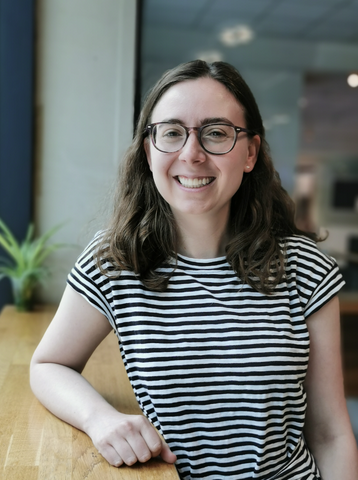
Meet Leo Baeck Fellow Tamar Aizenberg, part of the 2024-25 cohort, whose research offers fresh perspectives on memory, family, and Holocaust history.
Can you briefly describe your doctoral research project for a non-specialist audience? What drew you to this particular topic?
My research is an experiential history of the grandchildren of Jewish Holocaust survivors and the grandchildren of Holocaust perpetrators, or the third generation, in Austria, Germany, and the United States. I study how these grandchildren learn about their family history, why they become interested in it, and how they go about exploring the past on their own terms. Despite their different family histories and backgrounds, the grandchildren of survivors and the grandchildren of perpetrators have had similar experiences learning about the past from their families and take similar steps to uncover the past independently. As an undergraduate, I was drawn to the topic of grandchildren of survivors because I saw “third generation” groups being founded in the United States (where I’m based) and elsewhere. I wanted to understand this new phenomenon in Holocaust memory. When I began my PhD, I wrote a short research paper on documentaries featuring the grandchildren of perpetrators, and I saw parallels between their experiences and those of the grandchildren of survivors. These commonalities were surprising to me and led me to examine these grandchildren together in my dissertation.
Why is it important to study this topic now? What relevance does it have for today’s world?
Understanding the experiences and perspectives of the grandchildren of survivors and grandchildren of perpetrators is timely because they are typically the last generation to have known the generation of witnesses to the Holocaust. Grandchildren of survivors in particular are often seen, by themselves and others, as responsible for carrying on the memory of their grandparents and the Holocaust. Knowing how the third generation approaches the memory of the Holocaust can explain certain remembrance practices we see and give a sense of what kind of remembrance programming is most meaningful for them.
What have been the most rewarding and most challenging aspects of your academic journey so far?
One of the primary sources for my dissertation is about 50 interviews I conducted with the grandchildren of survivors and the grandchildren of perpetrators between 2022 and 2024. Conducting these interviews has been both the most rewarding and the most challenging aspect of my academic journey. The interview experience is always special. I enjoy hearing others’ stories and feel honored that I get the chance to tell their narratives through my research. On the other hand, the logistics behind the interviews can be challenging. Identifying potential grandchildren of perpetrators to interview in Germany and Austria was especially difficult. I’m grateful to everyone who helped me find interviewees.
What will be your next step in your work – and how has it been inspired by the fellowship seminar?
I’m currently writing my dissertation and preparing to submit it later this academic year. The fellowship seminar in London provided me with new inspiration to continue to do this work. I appreciated receiving thoughtful feedback on my work, and learning about the other fellows’ research and methods reminded me of how much I enjoy the field of German-Jewish Studies.
Is there a book, artwork, or historical figure that has particularly inspired you in your studies?
A History of the Grandparents I Never Had by French historian Ivan Jablonka is a book I read when I was just beginning to develop an interest in the third generation as an undergraduate, and I’ve returned to this book many times since. Every time I read it, I’m moved by how Jablonka weaves together his personal experiences as the grandson of Holocaust victims and his academic research. I often think about his exploration of the connections between family history and the study of history as I write about the third generation’s narratives in my own work.
Photo: Anna-Lena Kaufmann