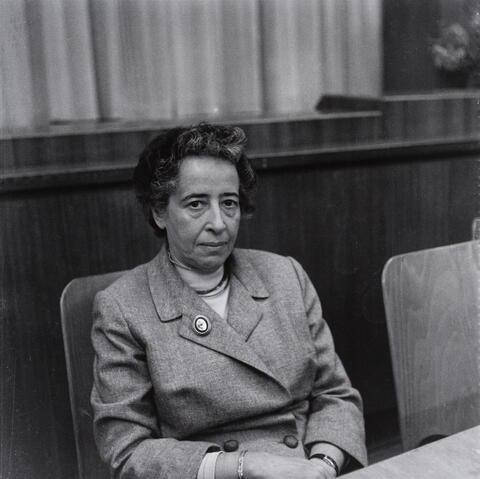
Today, 4 December 2025, marks 50 years since the death of Hannah Arendt, the German‑Jewish political thinker whose work continues to shape how democracies understand power, evil and responsibility. Widely regarded as one of the 20th century’s most original public intellectuals, she was also among the founders of the Leo Baeck Institute, helping to establish it as a key centre for the study of German‑speaking Jewry.
Born in 1906 in Hanover and raised in Königsberg, Arendt fled Nazi Germany in 1933, eventually reaching the United States after periods of internment and exile in Europe. Her experience of statelessness and persecution informed her landmark study The Origins of Totalitarianism, which examined how modern regimes could strip individuals of rights, identity and, ultimately, life itself.
Over the following decades, Arendt produced a series of influential works, including The Human Condition and On Revolution, in which she explored freedom, political action and the fragile nature of public life. Her report on the trial of Adolf Eichmann, later published as ‘Eichmann in Jerusalem’, introduced the controversial notion of the ‘banality of evil’ and sparked intense debate about guilt, obedience and moral judgment in the wake of the Holocaust.
Alongside this intellectual legacy, Arendt played a formative role in creating the Leo Baeck Institute in the 1950s, joining other émigré scholars to secure the archives and cultural memory of Central European Jewry. The Institute’s ongoing work in New York, Berlin, London and Jerusalem reflects her conviction that history must be documented carefully if citizens are to understand the political disasters of the modern age.
Half a century after her death in New York in 1975, Arendt’s questions about truth, responsibility and the vulnerabilities of democratic societies remain strikingly current. For the Leo Baeck Institute, this anniversary is not only a moment to remember a founding figure, but also an invitation to revisit the challenges she posed to complacency, conformity and forgetting in the face of history’s darkest chapters.
Photo: Wikipedia