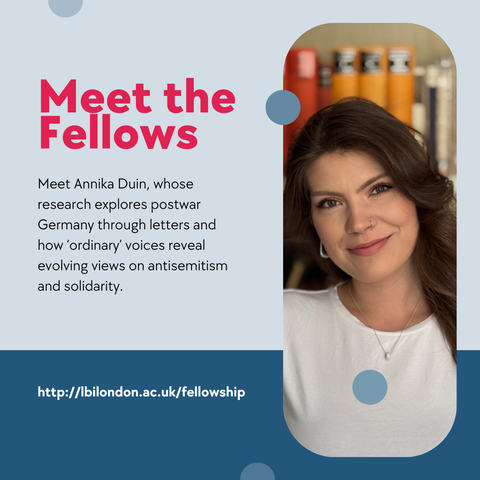
The latest feature in the Leo Baeck Institute’s Meet the Fellows series introduces Annika Duin, whose research examines how West Germans responded to antisemitism after 1945. Drawing on letters written by non-Jewish citizens to Jewish individuals and communities, her work traces how people discussed guilt, responsibility, and the Nazi past in everyday correspondence.
Can you briefly describe your doctoral research project for a non-specialist audience? What drew you to this particular topic?
My research project examines how antisemitism was perceived and responded to in the “old” Federal Republic of Germany, focusing on letters written by members of the non-Jewish population. By analysing these voices “from below,” I explore changing forms of solidarity as well as patterns of ignorance, trivialisation, and, in some cases, the reproduction of antisemitic attitudes. I first encountered these letters by chance through a footnote, but they quickly captured my full attention. What is particularly compelling about this material is the depth of insight it offers: letters often reveal far more than one might initially expect, functioning like fragments and extensions of public discourse. I began working with them in my master’s thesis, which focused on the antisemitic incidents of 1959/60 and the ways people responded. I now aim to extend this approach to further cases, tracing how interpretive and argumentative patterns evolved over time in these letters.
What do you hope your research will reveal or change in our understanding of German-Jewish history or culture?
I hope to uncover the roots of contemporary approaches to antisemitism by analysing the reactions of “ordinary people” across the breadth of society in postwar Germany. While these letter writers by no means represent the population as a whole, their voices illuminate how ambivalent attitudes towards antisemitism persisted in the postwar decades. Even when writers expressed solidarity, their letters often simultaneously contained forms of othering. Tracing how these ambivalences evolved over time is a central aim of my project. I seek to show that the relationship between Jews and non-Jews between 1945 and 1990—particularly in relation to the Nazi past as well as to Israel—was shaped by ambivalences and projections. Even well-intentioned expressions often provided a fertile ground for both anti- and philosemitism.
Have you encountered any surprising findings or challenges in your research so far? How did you address them?
In the search for letters, one repeatedly encounters extraordinarily rich and revealing material. Particularly striking is the extent to which correspondents disclose personal experiences in letters addressed to Jewish individuals or institutions. For instance, one man, writing to express solidarity with the Jewish community in Cologne in the context of the so-called “swastika epidemic” of 1959/60, recounted that several of his family members had been murdered in Auschwitz-Birkenau. As multilayered and fascinating as this material is, locating it presents significant methodological and practical challenges. Overcoming these challenges requires extensive archival work as well as careful guidance and supervision.
Why is it important to study this topic now? What relevance does it have for today’s world?
Eighty years after the end of the war, things have once again become sayable in the Federal Republic that many believed would never re-enter the public sphere. At the same time, antisemitic violence has persisted and, in many contexts, intensified, continuing to shape and endanger Jewish life. After 1945, public life was largely governed by a norm of anti-antisemitism, yet underlying attitudes received far less scrutiny. Letters written in response to antisemitic incidents, alongside survey data, help to address this gap by revealing how projections onto Jews—sometimes well-intentioned—enabled stereotypes to persist. They also illuminate why antisemitism never entirely lost its potential for reactivation.
How did your previous studies or experiences prepare you for this research?
My previous research focused on the history of antisemitism in the late nineteenth century; for instance, I wrote my bachelor’s thesis on the Dreyfus Affair. This background allows me to connect the history of antisemitism across the nineteenth and twentieth centuries, which is often artificially divided into “before” and “after” the Shoah. Although National Socialism marked the culmination of Jewish persecution, racialised ideas predated it and did not disappear after the Second World War; rather, they persisted and continued to shape postwar attitudes, providing an important framework for the analysis of my sources.
What have been the most rewarding and most challenging aspects of your academic journey so far?
One of the most rewarding moments of my academic journey was receiving the prize for the best master’s thesis from the Faculty of Philosophy at the University of Cologne, after months of work and self-doubt. My supervisor had passed away just a few weeks earlier, which gave me the opportunity to honour him during my acceptance speech. At the same time, this experience was—and in some ways still is—one of the most challenging aspects of my academic path: learning to transform grief into motivation.
What motivated you to apply for the Leo Baeck Fellowship? What do you hope to gain from being part of this international cohort?
What particularly fascinated me about the Leo Baeck Fellowship is its orientation: it brings together international researchers from different disciplines and periods, all united by a focus on German-Jewish history and culture. I was also very intrigued by the collaboration and institutional connections, with the fellowship being supported by the Studienstiftung des deutschen Volkes and organised in substantive cooperation with the Leo Baeck Institute London and the Leibniz Institute for Jewish History and Culture – Simon Dubnow.
How do you think the fellowship’s workshops and international community will influence your research and academic development?
I believe the structure of the fellowship strongly encourages thinking beyond one’s own project and thus incorporating transnational perspectives. Its interdisciplinarity also adds depth to my work and highlights research approaches I might not have considered otherwise. Since I am still at a very early stage of my project, I can incorporate and adjust many aspects of my project based on the highly constructive and supportive feedback of the fellows and supervisors. Overall, I believe this experience will make my project significantly more robust and well-founded.
What will be your next step in your work – and how has it been inspired by the fellowship seminar?
I am revisiting the conception of my project, focusing on the selection of cases of antisemitic incidents between 1945 and 1990. The guidance I have received has been invaluable in helping me trace the dynamics of when and how people addressed Jewish individuals and institutions. Certainly, I will continue to search for additional letters, and any recommendations are always warmly welcomed!
If you could share one insight or piece of advice with future researchers interested in German-Jewish studies, what would it be?
Never doubt yourself too much, and don’t be afraid to ask for help! There will always be someone capable and willing to support you in this field, even if it doesn’t feel that way now.
Outside of your research, what are your interests or hobbies? How do they influence or balance your academic life?
I really enjoy strength training because it helps me channel my emotions and counteract the effects of sitting at a desk all day. I believe it is important to remember that we are not only researchers, but also, for example, sportspeople, readers, friends, sisters, or daughters. Maintaining this balance helps me relieve pressure and keep different perspectives.
Is there a book, artwork, or historical figure that has particularly inspired you in your studies?
The dissertation by my former supervisor Habbo Knoch, Die Tat als Bild, has been immensely helpful both methodologically and in understanding the socio-cultural contexts of the early postwar period. Its conceptual approach and breadth are impressive, motivating and inspiring me to explore the history in my own project with similar depth.