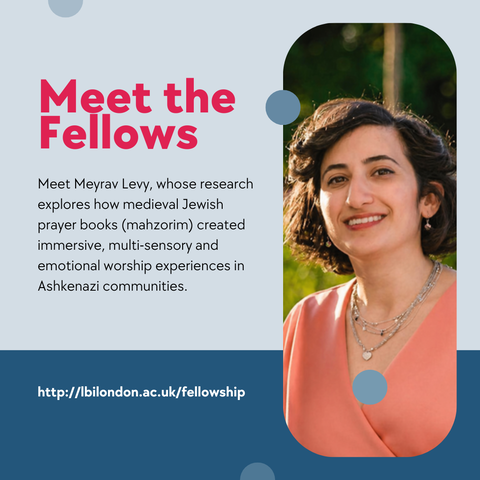
The latest feature in the Leo Baeck Institute’s Meet the Fellows series introduces Meyrav Levy, whose research examines mediaeval Jewish prayer books, known as mahzorim, and how they fostered multi-sensory, immersive, and emotional experiences for worshipers.
Can you briefly describe your doctoral research project for a non-specialist audience? What inspired you to pursue this topic?
My doctoral research explores how medieval Jewish prayer books, known as mahzorim, shaped religious experience in Ashkenazi communities during the 13th and 14th centuries. These monumental and richly illuminated manuscripts were not simply texts to be privately read, but objects that were seen, heard, and physically used during synagogue worship. By studying their poetry, images, page design, vocal markings, and material features, I investigated how these books fostered multi-sensory, immersive, and emotional experiences for worshipers. This research direction emerged from a dissatisfaction with mainstream approaches to Jewish prayer books. While working on Ashkenazi mahzorim during my M.A. studies, I realized that examining them solely through iconographic, stylistic, exegetical, or historical lenses offers only a partial view. Such methods provide access to the world of their production, but they do not fully reveal the function or effect of the ‘final product.’ The size of mahzorim, their eye-catching illustrations, the careful arrangement of their text layout, the vocalization signs and guiding marginal notes, clearly indicate that performance and ritual interaction are central to their essence. I was compelled to explore this overlooked dimension, which could also recover the lived, sensory experiences of the original Ashkenazi worshipers.
In what ways did your doctoral research prepare you for the work you are doing now?
Today, I work at the Bavarian State Office for Non-State Museums, advising Bavarian museums and former synagogues on the presentation of Jewish cultural heritage in ways that make this rich history more visible and engaging for visitors. The approach I developed in my doctoral research is highly relevant to this work. Whether dealing with an eighteenth-century Torah wimpel or a nineteenth-century silver coffee set owned by a Jewish family, I focus not only on the objects themselves, but also on the experiences and meanings they once carried for their Jewish users. This helps museums move beyond “dry” information such as date, material, or maker, and create exhibitions that communicate Jewish history in more vivid, sensory, and emotionally engaging way. The user-focused approach also informs my work on exhibition and mediation concepts more broadly, since it requires careful consideration of the visitors themselves—their perspectives, prior knowledge, and emotional and cognitive responses when encountering the objects on display.
What have been the most rewarding and most challenging aspects of your academic journey so far?
One of the most rewarding aspects of my academic journey has been presenting my research at international conferences and public events, and receiving genuine enthusiasm from audiences who seemed to share my fascination with the lived realities and emotional worlds of medieval Ashkenazi Jews. Those moments were especially meaningful because I hoped they might encourage other students and researchers to explore methodologies that go beyond purely intellectual or iconographic analysis and take sensory, emotional, and performative dimensions seriously as well. The most challenging aspect has definitely been academic writing. I naturally develop ideas through creativity, dialogue, and direct engagement with people, objects, and environments. Translating these dynamic and often intuitive processes into formal academic prose has always felt somewhat unnatural to me, and at times even restrictive. This was one of the main reasons I ultimately chose to leave academia in favor of museum work, where I can engage more directly with objects, spaces, and audiences.
If you could share one insight or piece of advice with future researchers interested in German-Jewish studies, what would it be?
I would advise future researchers to remain attentive to the constant tension between integration and distinct Jewish identity within diaspora life. Jewish objects, texts, images, and cultural practices often reflect both the desire to participate in the surrounding non-Jewish society and the simultaneous preservation of specifically Jewish traditions, memories, languages, and religious frameworks. In my view, some of the most fascinating insights emerge precisely from this complexity. Rather than seeing these elements as contradictory, it is often more productive to understand them as existing in continuous negotiation with one another.
Is there a book, artwork, or historical figure that has particularly inspired you in your studies?
One artwork that profoundly influenced me was Caravaggio’s The Supper at Emmaus, which I studied in my early twenties. Encountering this painting made me realize how powerfully religious art can engage viewers on both cognitive and sensory levels, even without prior theological knowledge. Elements such as the fruit basket that seems to extend into the viewer’s space, the outstretched hand of Cleopas, the dramatic lighting, and the depiction of a scene caught in mid-action are all artistic strategies designed to draw the viewer into the event itself. I found it deeply exciting to experience how effectively these techniques still work emotionally and physically, despite the more than four hundred years’ distance. I guess, it was one of the things that changed my perspective on religious artworks.