Skip to main content Publications | Leo Baeck Institute London

Publications

Welcome to the publications page of the LBI London, where you can explore our rich collection of works on German-Jewish history and culture. Our publications are divided into three main series:


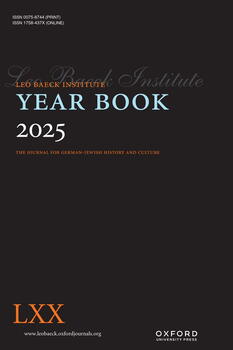
  • Leo Baeck Institute Year Book: Published by Oxford University Press, this flagship journal has been a premier platform for academic research in German-Jewish studies since 1956, featuring diverse perspectives and primary documents.
  • Schriftenreihe wissenschaftlicher Abhandlungen des Leo Baeck Instituts: This academic series, launched in 1959, offers monographs and edited volumes covering a broad spectrum of historical topics from the Enlightenment to the modern era.
  • German Jewish Cultures: Published by Indiana University Press, this series showcases innovative research at the intersection of Jewish and German studies, embracing a wide range of methodologies and historical periods.
Johannes Sabel

In the 19th century, German Jewry went through a sweeping process of modernisation, during the course of which two central pillars of Jewish tradition were taken and redefined: the law and exegesis, Halacha and Aggadah. Both were rendered fertile soil for the scientific, literary and emancipatory goals of the modern age. Johannes Sabel sets out to trace these developments.


74 Sabel, Johannes: Die Geburt der Literatur aus der Aggada (2010, 296 pp.)

Preface by John Grenville and Raphael Gross


I. DISCUSSION

The Future of German-Jewish Studies


II. JEWISH IDENTITY, PHILOSOPHY AND RELIGIOUS THINKING

NIMROD ZINGER: “Our hearts and spirits were broken”: The medical world from the perspective of German-Jewish patients in the seventeenth and eighteenth centuries

CHRISTIAN WIESE: “Let his Memory be Holy to Us!”: Jewish Interpretations of Martin Luther from the Enlightenment to the Holocaust

MARTINA URBAN: Towards what Kind of Unity? David Koigen, Leo Baeck and the …

Daniel Wildmann

What links gymnasts with harmony, masculinity and being Jewish? And why do such questions indicate fracturing in Jewish integration into the German Empire? Daniel Wildmann seeks to answer these questions and offers a new perspective on the practices of Jewish self-understanding around 1900.


73 Wildmann, Daniel: Der veränderbare Körper (2009, 329 pp.)

Preface by John Grenville and Raphael Gross


I. THE PERCEPTION OF JEWS IN GERMAN SOCIETY

AYA ELYADA: Yiddish—Language of Conversion? Linguistic Adaptation and its Limits in Early Modern Judenmission

CHRISTIAN STUART DAVIS: Colonialism and Antisemitism during the Kaiserreich: Bernhard Dernburg and the Antisemites

MICHAH GOTTLIEB: Publishing the Moses Mendelssohn Jubiläumsausgabe in Weimar and Nazi Germany

DAVID HEREDIA: Der Spiegel and the Image of Jews in Germany: The Early Years, 1947–1956


II. IMMIGRATION AND…

Preface by John Grenville and Raphael Gross


I. JEWISH IDENTITY

AMY BLAU: Claims of Language: Translation as a Mediation of Jewish Identity and the Yiddish Reception of Nelly Sachs

MANFRED JEHLE: “Relocations” in South Prussia and New East Prussia: Prussia’s Demographic Policy towards the Jews in Occupied Poland 1772–1806

JONATHAN M. HESS: Fiction and the Making of Modern Orthodoxy, 1857–1890: Orthodoxy and the Quest for the German-Jewish Novel

DAVID RECHTER: A Nationalism of Small Things: Jewish Autonomy in Late Habsburg Austria…

Ulrich Charpa and Ute Deichmann (Editors)

This collection studies the relationship between the cultural, religious and social circumstances of German-speaking Jews and their academic work.


72 Charpa, Ulrich / Deichmann, Ute (eds.): Jews and Sciences in German Contexts, (2007, 312 pp.)

Preface by John Grenville and Raphael Gross


I. SUSTENANCE FOR THE SOUL

MICHAEL A. MEYER: German Jewish Thinkers Reflect on the Future of the Jewish Religion

UTA LOHMANN: “Sustenance for the Learned Soul” The History of the Oriental Printing Press at the Publishing House of the Jewish Free School in Berlin


II. JEWISH LIFE AND SOCIETY: FROM THE NINETEENTH TO THE TWENTIETH CENTURY

REINHARD RÜRUP: Jewish Emancipation and the Vision of Civil Society in Germany

STEVEN M. LOWENSTEIN: Reflections on Statistics: Hopes and Fears…

Hanna Delf von Wolzogen and Itta Shedletzky (Publishers)


Theodor Fontanes earliest, continuous collection of letters is his correspondence with the Ukrainian Jewish writer Wilhelm Wolfsohn. These manuscripts will be academically published for the first time, accompanied by a collection of essays which shed light on the biographical and cultural context behind the letters.


71 Wolzogen, Hanna Delf von / Shedletzky, Itta (eds.): Theodor Fontane und Wilhelm Wolfsohn – eine interkulturelle Beziehung, (2006, 548 pp.)

Preface by John Grenville and Raphael Gross


I. INTELLECTUAL RESISTANCE IN THERESIENSTADT

MIRIAM INTRATOR: The Theresienstadt Ghetto Central Library, Books and Reading: Intellectual Resistance and Escape During the Holocaust


II. LITERARY INTERPRETATION AND INTELLECTUAL HISTORY

ELIZABETH PETUCHOWSKI: “Ein Wort—du Weißt”: Finding a Solution to a Riddle in Paul Celan’s Poem Nächtlich Geschürzt

JOEL GOLB: Celan’s “Tones”: A Reading of HUHEDIBLU

PAUL MONOD: Reading the Two Bodies of Ernst Kantorowicz

Hoffmann, Christhard (ed.)

Preserving the Legacy of German Jewry. A History of the Leo Baeck Institute, 1955-2005, (2005, 474 pp.)


Founded in May 1955 in Jerusalem by German-Jewish intellectuals who had survived the Holocaust - among them Martin Buber, Ernst Simon, Gershom Scholem, and Robert Weltsch - the Leo Baeck Institute of Jews from Germany (LBI) has been engaged in preserving the legacy of German Jewry by collecting material, doing research, and presenting historical narratives. Published on the occasion of the fiftieth anniversary of its founding, the present volume is the first to…

Preface by John Grenville and Raphael Gross


I. THE END OF THE WAR AND THE HOLOCAUST

ANDREAS KOSSERT: “Endlösung on the ‘Amber Shore’” The Massacre in January 1945 on the Baltic Seashore—A Repressed Chapter of East Prussian History


II. JEWISH INTELLECTUALS

CHRISTIAN WIESE: “For a Time I Was Privileged to Enjoy his Friendship…”: The Ambivalent Relationship between Hans Jonas and Gershom Scholem

JÖRG HACKESCHMIDT: The Torch Bearer: Norbert Elias as a Young Zionist

DOROTHEA MCEWAN: “The Enemy of Hypothesis”: Fritz Saxl as…

Marina Sassenberg

Selma Stern (1890-1981) the “grand old lady of German-Jewish historical scholarship” created an extensive corpus of literature about German-Jewish history in the modern era. Marina Sassenberg takes a look at the interaction between biography and historical understanding for of the first female German historians and the first woman in the scholarship of Judaism.

293 pages. ISBN: 978-3-16-162841-2 DOI: 10.1628/978-3-16-162841-2

Preface by John Grenville and Raphael Gross


I. RELIGIOUS RENEWAL

EDWARD BREUER AND DAVID SORKIN: Moses Mendelssohn’s First Hebrew Publication: An Annotated Translation of the Kohelet Mussar

ANDREAS BRÄMER: The Dialectics of Religious Reform: The Hamburger Israelitische Tempel in Its Local Context 1817–1938


II. JEWISH SOCIAL LIFE, ANTISEMITISM AND JEWISH REACTIONS IN IMPERIAL GERMANY AND DURING THE WEIMAR REPUBLIC

MARION KAPLAN: Unter Uns: Jews Socialising with other Jews in Imperial Germany

CHRISTOPH JAHR: Ahlwardt…

Michael Brenner, Vicki Caron, Uri R. Kaufmann

In this volume, leading historians, political scientists and literary scholars from all over the world make a systematic attempt at a comparative study of Jewish history in Germany and France in the modern era. The focus is the paradigmatic paths of Jewish emancipation in both countries, although current problems, like civil rights and the situation in modern day Europe, play a role as well.

VI, 245 pages. ISBN: 978-3-16-163597-7 DOI: 10.1628/978-3-16-163597-7

Ulrich Wyrwa

What caused the failure of Jewish emancipation in Germany? Intrigued by this question, Ulrich Wyrwa examines the specific accomplishments and the unique obstacles of Jews in the era of emancipation, using Prussian and Tuscan cities as examples.

IX, 491 pages. ISBN: 978-3-16-163143-6 DOI: 10.1628/978-3-16-163143-6

Preface by John Grenville and Raphael Gross


I. JEWISH INTELLECTUAL RESPONSES TO TRADITION AND MODERNITY

ASTRID DEUBER-MANKOWSKY: Walter Benjamin’s Theological-Political Fragment as a Response to Ernst Bloch’s Spirit of Utopia

LOUISE HECHT: “How the power of thought can develop within a human mind.” Salomon Maimon, Peter Beer, Lazarus Bendavid: Autobiographies of Maskilim Written in German


II. THE JEWISH ALLTAG IN THE EARLY MODERN PERIOD

ROBERT LIBERLES: Introduction

RACHEL L. GREENBLATT: The Shapes of Memory:…

Preface by John Grenville and Arnold Paucker


I. JEWS IN THE AGE OF METTERNICH

EDWARD TIMMS: The Pernicious Rift: Metternich and the Debate about Jewish Emancipation at the Congress of Vienna

NIALL FERGUSON: Metternich and the Rothschilds: “A Dance With Torches on Powder Kegs”?

R. J. W. EVANS: Progress and Emancipation in Hungary During the Age of Metternich

EDA SAGARRA: Grillparzer, the Catholics and the Jews: A Reading of Die Jüdin von Toledo (1851)

RITCHIE ROBERTSON: Karl Beck: From Radicalism to Monarchism

Selma Stern (Editor: Marina Sassenberg)

The German-Jewish historian Selma Stern (1890-1981) researched mythos and reality, the rise and fall of ‘Court Jew’ dynasties like Behrens, Ephraim, Gumperts, Itzig, Kann and Wertheimer. Marina Sassenberg presents the first German publication of this work.

X, 284 pages. ISBN: 978-3-16-163596-0 DOI: 10.1628/978-3-16-163596-0

Andreas Gotzmann, R. Liedtke, T. van Rahden

This publication documents the diversity of the Jewish bourgoisie across the different social classes, but also the limitations placed on this minority in Germany. The authors combine new discoveries in the field of German-Jewish history with the field of research concerning societies and social classes.

IX, 444 pages. ISBN: 978-3-16-163594-6 DOI: 10.1628/978-3-16-163594-6

Erika Bucholtz

Using the publisher Henri Hinrichsen as an example, Erika Bucholtz presents an important section of German-Jewish city, social and cultural history.. Her research is a cornerstone in the examination of the history of music labels and producers, a field within musicology, as well as social and cultural historiography, that has long been underappreciated.

VIII, 367 pages. ISBN: 978-3-16-163595-3 DOI: 10.1628/978-3-16-163595-3

Subscribe to our Newsletter

Latest Publications

Latest LBI Podcast Episodes