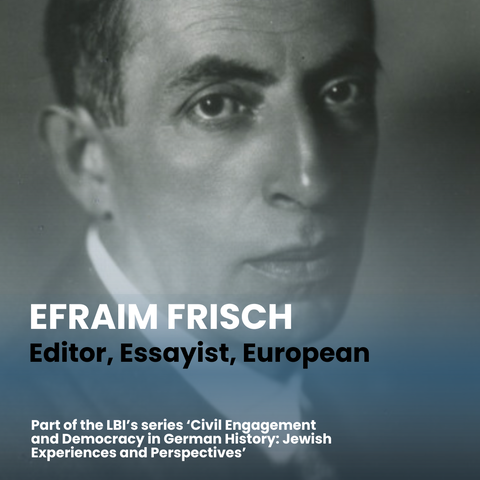
Efraim Frisch (1873–1942) was a writer and editor of the journal Der Neue Merkur, which from 1914 to 1925 provided a forum for liberal, international, and democratic voices. Raised in an Orthodox family in the Galician town of Brody, he turned early to secular studies and literature, without ever completely abandoning his religious roots. He moved in the circles of figures such as Martin Buber, Heinrich Mann and Christian Morgenstern, and was intellectually closely accompanied by his wife, the translator Fega Frisch. In his essays, he combined humanist ideals with sharp criticism of nationalism and antisemitism – long before these became the majority view in German society.
Dr Stephan Bauer is a trained political scientist and worked after his studies in political and social sciences in Munich between 2017 and 2023 at the University of Potsdam. In 2024, he published his dissertation entitled ‘Efraim Frisch and Albrecht Mendelssohn Bartholdy: Phases and Contexts of an Intellectual Double Biography (1900–1939)’. Since completing his doctorate, he has worked as an advisor at the Centre for International Peace Operations (ZIF) in Berlin. While academic work still gives him great enjoyment, he now pursues it mainly as a personal passion.
Lutz Vössing spoke to Dr Stephan Bauer about the unjustly almost forgotten intellectual.
You’re a trained political scientist and hold a doctorate in modern German history. How did you come to focus on the biography of the writer, publisher and theatre critic Efraim Frisch?
During research for an originally differently conceived dissertation project about the jurist Albrecht Mendelssohn Bartholdy and the journalism of German-speaking liberal internationalists of the interwar period, I came across this one encounter that I felt had had a decisive influence. That was the encounter with the magazine editor (Der Neue Merkur) and essayist Efraim Frisch. For the dissertation, this meant that the intellectual history and single biography became a double biography. The intensive work with Frisch’s estate also led to the thought that this life story of a ‘central fringe figure’, today largely forgotten, could not be exhausted in an intellectual biography alone. I am currently working on one of these other ways to pass on Frisch’s life.
Frisch comes from an Orthodox Jewish family, dropped out of training for the rabbinate, and then began studying law and philosophy. How did that happen?
He attended – as did Joseph Roth years later – the German-language Kronprinz-Rudolf-Realgymnasium in Brody and was – probably selected on account of his excellent language skills – the ‘German voice’ of the student group Zion in Lwiw. That he did not attend the rabbinical seminary in Vienna – which his father, a successful merchant, expected – but instead enrolled at the faculty of law, may have its origin in the fact that, even at 15, as Frisch himself once wrote, ‘inclination and disposition turned to freer and more worldly studies’ (at that time, incidentally, he was also part of the Ivriya theatre group in Brody). What makes Frisch so interesting is that this inclination did not lead to a break with his traditional upbringing; his lifelong project was rather to bring both into a deeper synthesis.
What brought him at the turn of the century to (fictional) writing and storytelling?
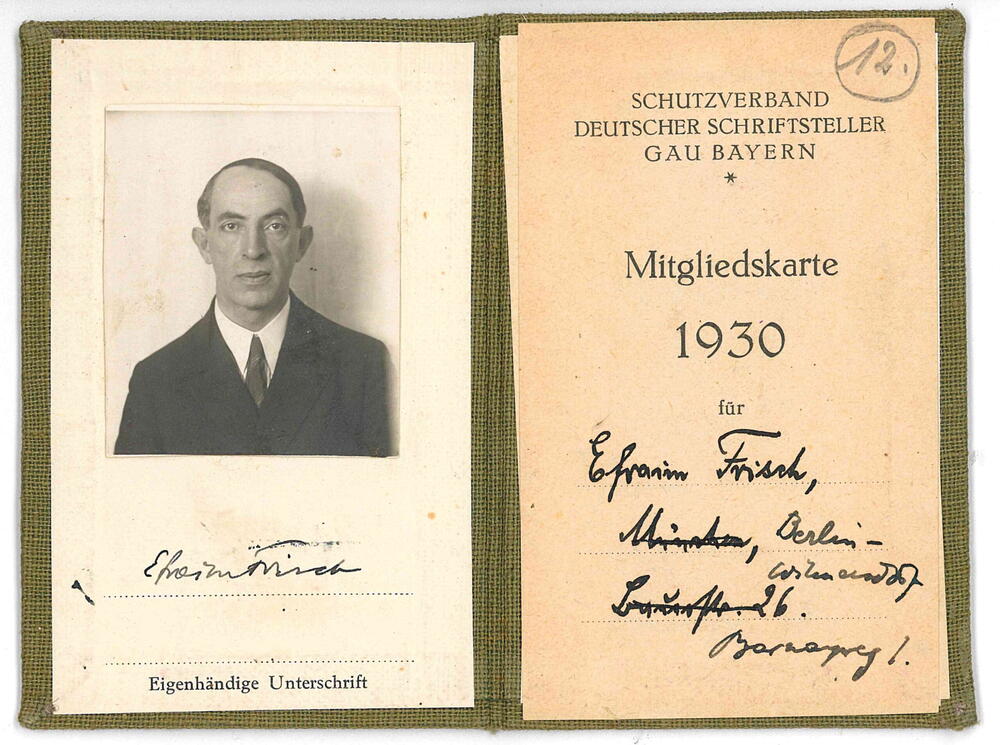
Above all, the creative milieu around the Berlin S. Fischer Verlag, where Frisch published his novel Das Verlöbnis in 1901. Today, one would call this an autofictional novel, dealing with the escape of a sensitive boy from the oppressive rural-Jewish background of Galicia’s Polish part.
Who were his first companions and influences?
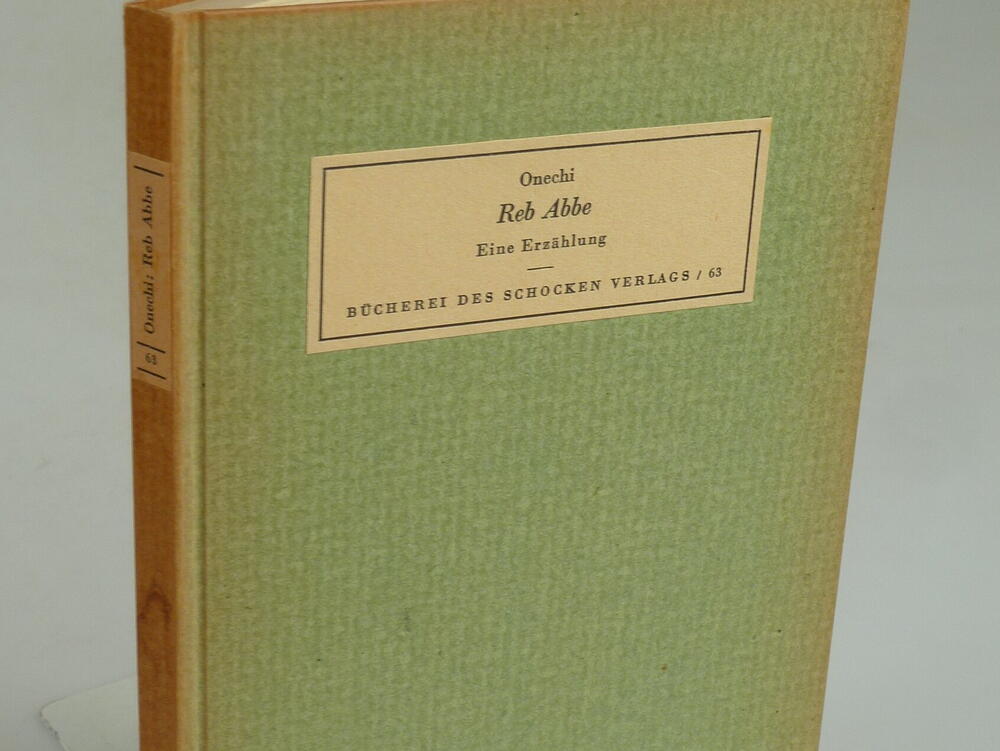
Those Frisch himself named were Micha Josef Berdyczewski – the collector of fairy tales and legends – and Moritz Heimann – the eminent editor at S. Fischer Verlag. Also a supportive friend and mentor was Christian Morgenstern and, within Berlin’s Donnerstagsgesellschaft, Martin Buber soon joined. With Buber and Heimann, Frisch was already planning a new translation of the Holy Scriptures in the early 1900s – a few years before the Buber-Rosenzweig version. What also seems important to me, and perhaps had greater influence, was his encounter with Fega Lifschitz of Grodno, later Fega Frisch, one of the great German translators from Russian. Due to the conventions of the time – especially around how marriage could be spoken about – much must be surmised here. But Efraim Frisch as a critic of Russian literature, as editor, founder and publisher of magazines, indeed as an author, cannot be imagined without Fega Frisch.
What can be said about the two?
I have not yet completed my collection and analysis of sources on this topic (if that’s even possible). My impression is that they had a very happy, fulfilling and intellectually stimulating relationship, in which both could pursue their intellectual passions equally – with Efraim Frisch more in production and Fega Frisch in translation. Their niece Bella Schlesinger, who played a major role in Jewish welfare work in the 1930s, was a kind of daughter to the childless couple. Then there were some close friendships that Fega and Efraim Frisch maintained as a couple. Both were very serious, profound and sought after conversation partners, e.g. for Thomas Mann, as evidenced in his diaries. Arthur Schnitzler dreamed about Efraim Frisch – who appeared in the dream as the ‘bad conscience’. There are also accounts from contemporaries such as the historian Alfred Vagts, who later stated that Efraim and Fega Frisch had, even in 1920s Munich – where Der Neue Merkur was published – a ‘craven fear’ of German antisemitism and had therefore withdrawn socially.
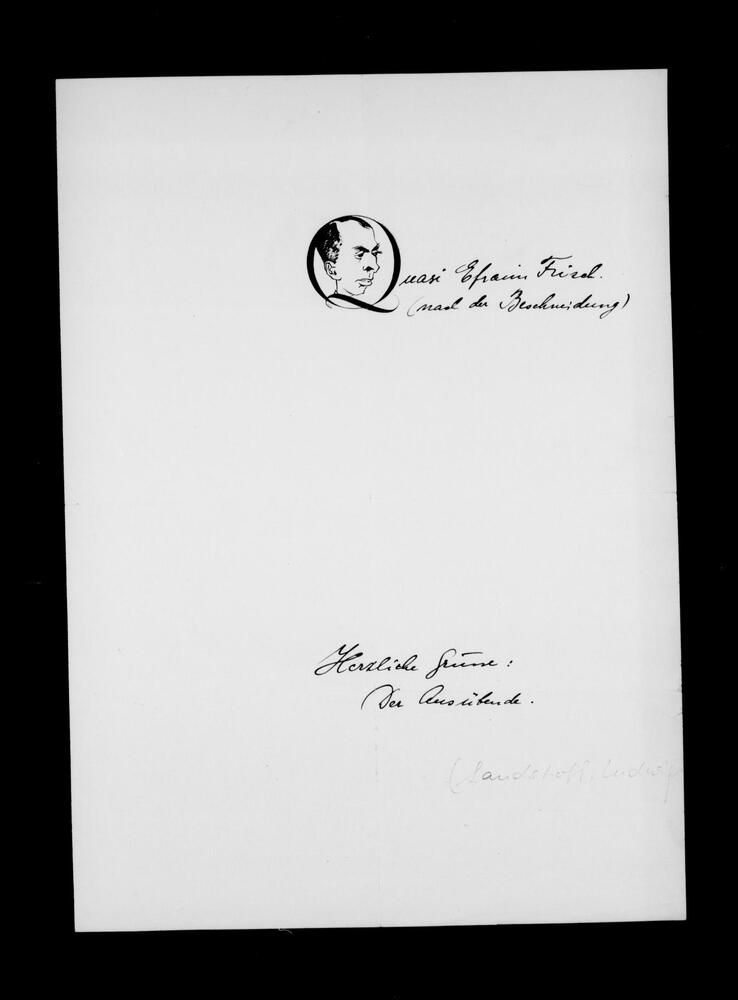
You have already mentioned Frisch’s role as editor of Der Neue Merkur. In what context did the journal appear? What was the editorial mission?
First: it was Frisch’s journal, published between spring 1914 and spring 1916, then interrupted because Frisch was called up for military service, and which ran again from the start of 1919 to September 1925. Only between 1919 and 1921 was there a second editor, Wilhelm Hausenstein. Frisch wanted always to publish a modernist magazine that could hold its own internationally, e.g. compared to Nouvelle Revue Française.
Before the First World War, Der Neue Merkur’s founding can be understood as part of the ongoing democratisation of the late Kaiserreich (there was talk of a spiritualisation of public life). Here, Frisch built on a specifically Munich tradition strongly connected to the Dreyfus Affair in France, the birth of the modern intellectual. During the war years, Frisch aimed more for critical-intellectual exploration of the causes of war, reflective rather than joining noisy war reporting. In these years, the magazine’s profile, oriented towards social democracy, also sharpened. After 1919, it was about hopefully serving a ‘spiritual gathering and renewal’. With Der Neue Merkur (as part of an international ‘magazine community’), the ‘European idea’ was to be kept vibrant and democracy made the crystallisation point for all intellectual energy. However, apart from intellectual engagement, Der Neue Merkur never quite succeeded in creating ‘vivid, concise, catchy terms, slogans, programmes, [and] confessions’ that staff member Otto Flake once demanded.
Which encounters during his editorial work were of particular importance to Frisch?
An editor always makes an offer, once said Franz Schönberner of Der Neue Merkur’s editorial team. But Frisch could not make such generous financial offers as, for example, Die neue Rundschau from S. Fischer Verlag. This circumstance always somewhat limited the circle of contributors and their loyalty. Contemporary distinction was made between a tighter circle of contributors Frisch could always depend on and an ‘imaginary circle’ – contributors Frisch hoped for, courted, and who, in his view, shaped the character of the journal, even if they contributed only once. Moritz Heimann and Erich (von) Kahler belonged to this group. Then there is the circle of contributors discernible through academic study of the completed magazine project. This group includes people very intensively involved throughout Der Neue Merkur’s existence – some even founding new journals or research institutes around Frisch’s initiative. These included co-editor Wilhelm Hausenstein; the liberal internationalist and head of the Hamburg Institute for Foreign Policy, Albrecht Mendelssohn Bartholdy; world traveller Alfons Paquet; writer Arnold Ulitz; essayist and European thinker Ferdinand Lion; Alfred Döblin; and – every modernist magazine has its poet – Klabund (Alfred Henschke). Altogether, approx. 340 (including ten female) authors wrote 825 contributions for Der Neue Merkur’s 88 issues.
Frisch’s editorial influence shaped later magazine editors such as Willy Haas (Die literarische Welt) and Stefan Grossmann (Das Tage-Buch). There were also influential ‘encounters’ – positively, e.g. with André Gide, and negatively, with Oswald Spengler.
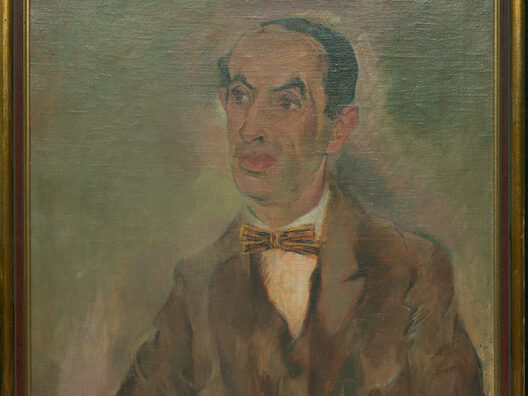
Do we know of other encounters with people from literature and art?
Literary scholar Guy Stern, who died in 2023 aged 101, gathered the magazine’s literary contributions in a book titled ‘Constellations. The Best Stories from Der Neue Merkur 1914 – 25’. Among others, it features Alfred Döblin, Robert Walser, Leo Perutz, Bertolt Brecht, Heinrich Mann, Regina Ullmann, Robert Musil and Franz Kafka. Worth noting, the first serial novel in the magazine in 1914 was Jakob Wassermann’s ‘Das Gänsemännchen’, which helped launch Wassermann’s career. Der Neue Merkur also published Frank Wedekind’s critical Bismarck drama, which advocates of rapprochement diplomacy within the German Society 1914 appreciated during the war. Frisch, with his international connections, was able to publish Maxim Gorky’s ‘Recollections of Leo N. Tolstoy’ in Germany for the first time. Marcel Proust would have been willing to publish ‘Fragments’ with Der Neue Merkur, but its small accompanying press operated only in 1919 and 1920. In the field of art history and criticism, Frisch, cousin to gallery owner J. B. Neumann, left this to Wilhelm Hausenstein and Julius Meier-Graefe.
Looking back, what significance did Der Neue Merkur have in the time before and early Weimar Republic?
Frisch’s Der Neue Merkur should – echoing the gesture of magazine entrepreneur Christoph Martin Wieland – be seen as an attempt to establish a German magazine on the scale of Mercure de France (and the Nouvelle Revue Française). The magazine, as reflected in references and citations, fit into a European – transatlantic network of little magazines (modernist magazines). This means a media communication space in the early twentieth century relevant for international relations during World War I and the founding years of the Weimar Republic, enabling a new, ‘other Germany’ to be perceived and spoken of – with political and economic relevance. Thus its significance is as a mosaic in the history of German democracy in the liberal – internationalist era (‘Germany’s long road west’), with Frisch a ‘central fringe figure’ not yet remembered in culture. In his time – as Albrecht Mendelssohn Bartholdy bitterly said in 1933 – Der Neue Merkur (like related Mendelssohn Bartholdy projects) was a deception, a deception of the ‘individuals’, the ‘few’ – concerning the ‘many’.
Was Der Merkur known outside Germany?
Thanks to further digitisation projects in the field of (small) magazine research, we hope soon to better trace references, assess circulation (even globally and transnationally) evidence-based. For Der Neue Merkur: in 1922, the Nouvelle Revue Française praised Frisch’s initiative and highlighted the magazine’s suitability to offer orientation and keep traditions alive in a time of ‘permanent metamorphoses’. Nothing could better sum up Frisch’s aims. During World War I, mainly like-minded magazines in England, France, Switzerland and Italy paid attention to Der Neue Merkur’s content and summarised its contributions. In the years of modern conference diplomacy, Der Neue Merkur sometimes acted as a transport medium for texts by liberal scientists and politicians from Germany who shared it when meeting colleagues abroad.
With Munich as the place of publication, Der Neue Merkur was also a local phenomenon – and perhaps its greater significance lies in the awareness it brought to German readers about the interdependencies of the globalised world of the early twentieth century. This is emphasised by the fact that Frisch initiated, from 1919, together with friends like Paul Marc (brother of Franz Marc), a weekly press review with translations of central articles from dozens of foreign newspapers and magazines: Auslandspost at Der Neue Merkur. Such educational work, from a liberal-internationalist and democracy-history perspective, seems highly relevant.
Finally, how should Frisch’s life’s work be understood and evaluated politically?
If Frisch’s ‘life’s work’ is taken as the editing of Der Neue Merkur, his later engaged essay writing, and his publishing activity, he is part of the ‘intellectual class’ emerging in the 1920s, which simply belongs to – as contemporary Gustav Radbruch put it – ‘the sociology of democracies’ (the converse is true: a mark of non-democratic states is to silence this class). Frisch was committed to the Republic, recognised early on the danger repressive forces and fascism posed for European democracies – and saw himself as a warning voice. He thought about mechanisms later discussed in human rights protection as ‘responsibility to protect’; that is, he valued inviolability of the individual above state sovereignty. This likely also related to his experience, as a Jew born in Galicia in 1873, of violent contexts, and made him sensitive to how German majority society ‘treated’ Jewish minorities.
Especially worth mentioning is his central essay ‘Jewish Notes’ from 1921 – and the fact that, in Frisch’s view, the resource of Jewish (moral) universalism played a defining role but had not yet been realised. State structures for him were power entities that could only claim a certain ‘lesser’ loyalty. With French culture (‘grown in royal, bourgeois and revolutionary times’), Frisch allowed a form of cultural assimilation – which he saw as a ‘different kind of population increase’ compared to the biological idea of the 1930s. Frisch described the individual self as ‘political–national–religious–cultural’ – implying that there’s a sphere of life inaccessible to political – cultural assimilation or acculturation.
How did he, who was active in the student group Zion, view issues like assimilation, Zionism and Jewish – German life generally?
As Zion student group spokesperson, it was about reform ‘in the inner life of Jewish congregations’ in Galicia ‘in political, material, intellectual and ethical respects’. That characterises his lifelong standpoint toward Zionism. There can be found no deeper engagement with Zionism – Frisch also argued religiously from a different perspective. On German-Jewish life: Frisch’s contemporary assessment matches Gershom Scholem’s statement that there had never been a German-Jewish conversation, because the German majority was never ready for it, lacking – again Frisch – ‘love’ (‘human love’) as the unconditional prerequisite for a meeting on equal terms.
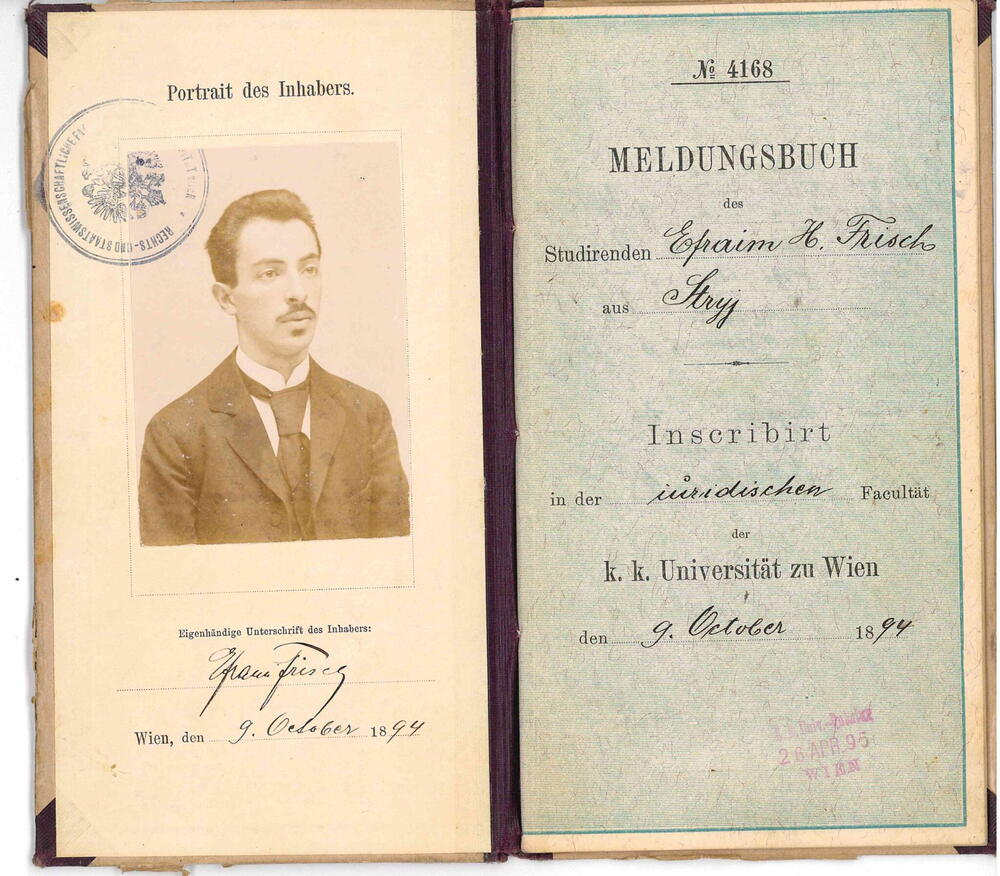
What does the historical figure Frisch ultimately represent? Mendelssohn Bartholdy has already attested something tragic to his life’s work…
Yes, Albrecht Mendelssohn Bartholdy saw the achievement of that group of people including Efraim Frisch at the end of their work in Germany as tragic. They proved powerless to help the ‘other Germany’ triumph – and Frisch suffered until his death in exile in 1942 over the course German society had taken. Not that they could have actually changed anything themselves. Still, I see Efraim Frisch, who for years (without fear ‘of a life in poverty’) asserted himself passionately and hopefully for this contemporary ‘other Germany’ – and this is why he speaks to us today. The historic figure Efraim Frisch stands for personal commitment in politically uncertain times, and for optimism that the enlightenment ideal of a democratic republicanism and universal equal rights for all will prevail.
I also see Efraim Frisch working in Swiss exile (with his wife Fega), reflectively returning to his Judaism and beginning work on a ‘great novel about the Jews’. Frisch is one of the last representatives of that Ashkenazi Judaism whose potential – if we follow Frisch’s suggestion – could not be realised. There is much transmission work still to do and much to reconsider, for every later generation anew, so as not to forget, as Michael Brenner says, what was destroyed.
Text: Lutz Vössing
This article is part of the series ‘Civil Engagement and Democracy in German History: Jewish Experiences and Perspectives’, first published in German as Engagement & Demokratie in der jüdisch-deutschen Geschichte by the Freunde und Förderer des Leo Baeck Instituts. You can read the article in the original German here:
https://fuf-leobaeck.de/2025/09/efraim-frisch-herausgeber-essayist-europaeer/