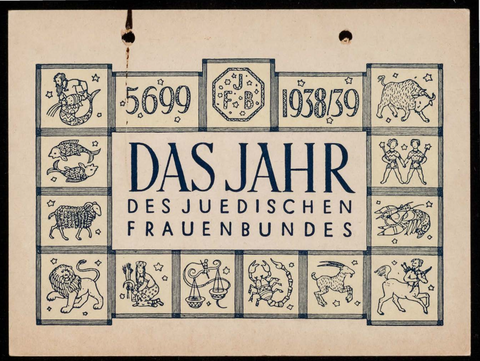
Gathered around the table in Berlin sit members of the Salomon family, with their children at their side and portraits of their ancestors watching over them. The scene, drawn by an anonymous artist around 1850, appears nestled in a rare Jewish calendar from 1938, of which a copy exists in the LBI London Pamphlet Collection.
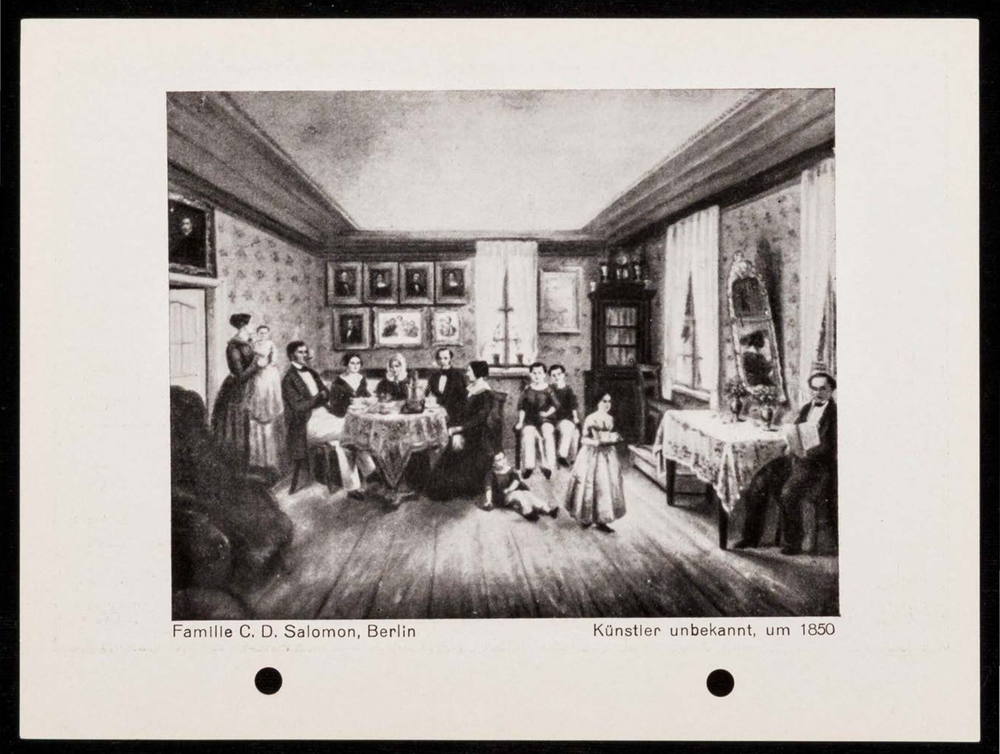
At first glance, the family portrait evokes the world of German-Jewish salon culture in the early 19th century, highlighting domesticity, bourgeois family values and belonging. Yet its inclusion in a calendar in 1938 gives the image a different resonance. Published at a moment when Nazi persecution violently reshaped and ultimately destroyed Jewish life in Germany, the calendar invites us to ask what the messages its editors sought to convey to an audience facing an increasingly uncertain future. ‘Das Jahr des Juedischen Frauenbundes’ (‘The Year of the Jewish Women’s Association’) for the year 1938/1939 is more than a handy sheet almanac. Rather, it deliberately transforms familiar images of Jewish domesticity into a statement of cultural continuity, dignity and resilience.
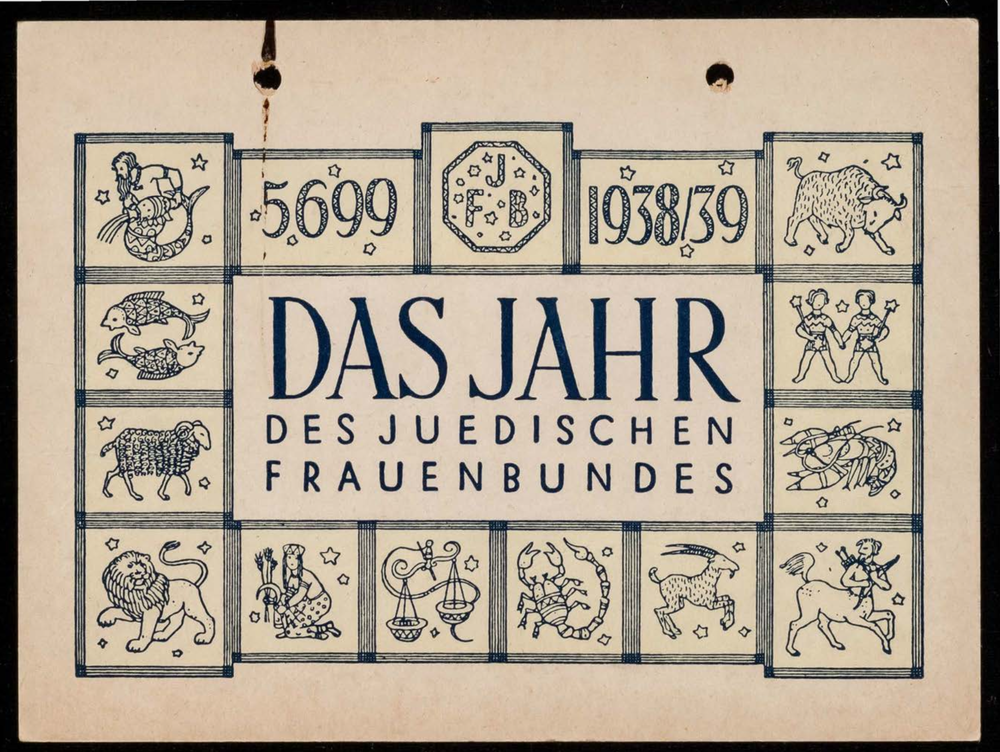
‘Das Jahr des Juedischen Frauenbundes 1938/39’ would be the final calendar published by the Jüdische Frauenbund, an association of Jewish women’s organisations in Germany, which centred on welfare, women’s education, communal life and feminist issues. As a feminist organisation, the Frauenbund placed particular emphasis on domestic space and women’s experiences, positioning women not merely as caretakers, but as central agents of Jewish identity and continuity. The publication of yearly calendars started in 1927 as a service to members and supporters of the Frauenbund and a way to raise crucial funds for the organisation. The JFB calendars enjoyed great popularity, as noted for example by the writer Bertha Badt. In a review of the 1931 calendar, she remarks that within a few years they had become a fixed part in German-Jewish households. They were edited by Lisbeth Cassirer (1886–1974) and Hannah Karminski (1897-1943), leading figures of the Jüdischer Frauenbund, and produced in cooperation with art historians and German-Jewish publishers. Each calendar had a particular theme, such as music (1936), the Jewish book (1934) or, in our case, the Jewish family.
Calendars, by nature, are ephemeral objects with a clearly defined purpose after which they tend to be discarded or stowed away. They may be beautifully illustrated or contain inspiring quotes from a wide range of literature, like the one of the Frauenbund. But they are, after all, documents with a clear use-by date. A sheet almanac to be hung up on a wall, ‘Das Jahr des Juedischen Frauenbundes 1938/39’ includes weekly Shabbat times and provides sufficient space for adding short notes and reminders by hand. Yet, it also functions as a cultural object. It is richly illustrated and carefully curated, bringing Jewish history, literature and visual culture into the domestic sphere. As the editors suggest, it could even serve as a lovely gift for the Jewish New Year or Channukkah. Curated by and for women, its quotes and illustrations often highlight aspects of modern Jewish womanhood and the central role of the mother.
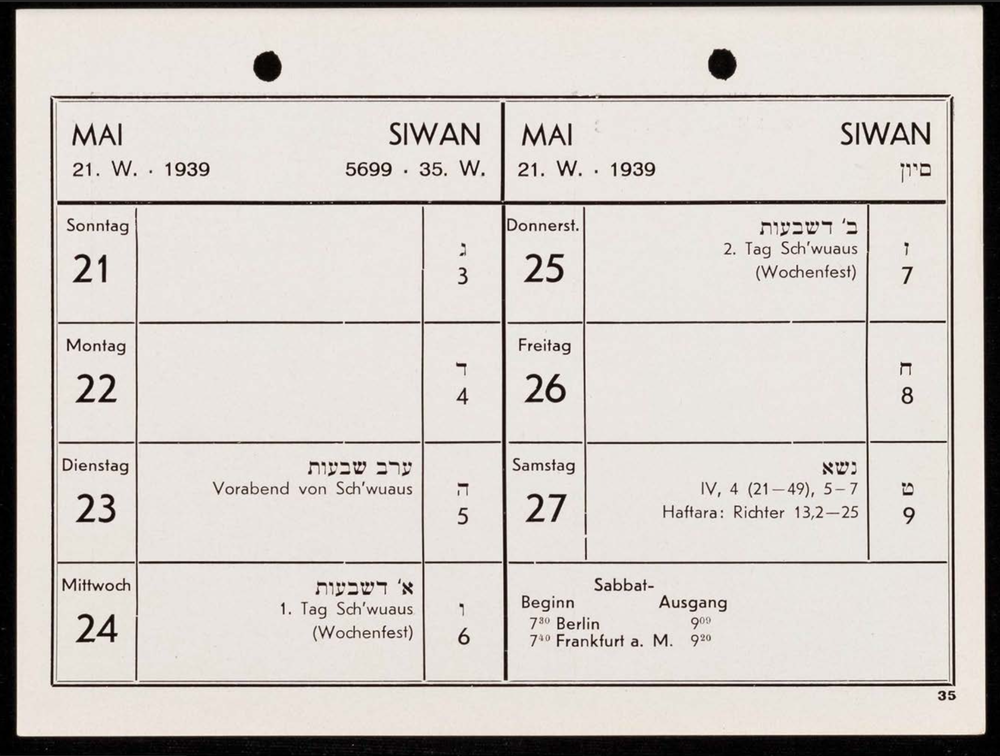
The calendar published in time for Jewish New Year celebrations in September 1938 was one of the last publications of the Jüdischer Frauenbund before its forced dissolution after the November Pogroms. The LBI London’s Pamphlet collection owes its rare copy of this calendar to Robert Weltsch, one of the founders of the Leo Baeck Institute London and its first director. ‘Das Jahr des Juedischen Frauenbundes’ is a unique witness in the LBI London’s collection: only very few other editions of the calendar are held in research libraries across the world. The JFB took pride in its calendar series, though: its monthly publication, the Blätter des Jüdischen Frauenbundes, now available through the Freimann Sammlung, serves as a rich resource for information about the initiative that led to its publication, featuring reviews as well as reports by the editors.
The Jewish family is the guiding theme of the 1938 calendar, with quotations and illustrations expressing family values shared across German-Jewish communities of the past and present. Quotes from important Jewish thinkers of the past, such as Rabbi Samson Raphael Hirsch or Moses Mendelssohn, are equally cited alongside writings by contemporaries such as Margarethe Susman, Ismar Elbogen and Bertha Pappenheim, founder of the JFB. They highlight the important role of the family in Jewish education and the special role of Jewish mothers in raising their children as Jews steadfast in their identity and knowledgeable about their heritage. Accompanying photos, illustrations and artworks, again both historical and contemporary, showcase family scenes and portraits, including Bertha Pappenheim and family members of the editor Lisbeth Cassirer.
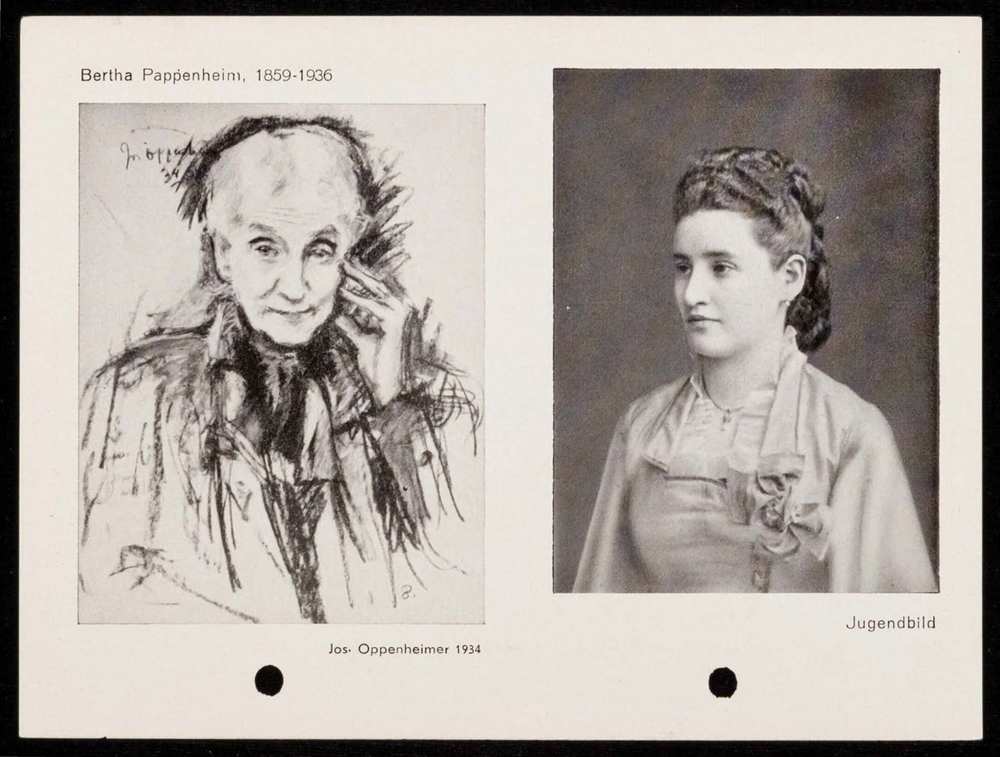
Editors and reviewers stressed that the JFB’s choice of annual themes was never arbitrary. Rather, the calendars can be viewed as Zeitbilder, as glimpses into the time in which they were published. As books by Jewish authors and dissidents of the Nazi regime were looted, banned and burned, the JFB responded with a calendar on the rich Jewish book culture in 1934. Likewise, the pictures and messages in the calendar from 1938 are in stark contrast to those used in Nazi propaganda. Confronting the antisemitic stereotypes of weakness, rootlessness and corruption that sought to exclude German Jews from society, the JFB’s choice of pictures show Jews – men and women – assertive of their identity. They are educated, part of a multigenerational community, intellectually engaged and connected religiously and culturally.
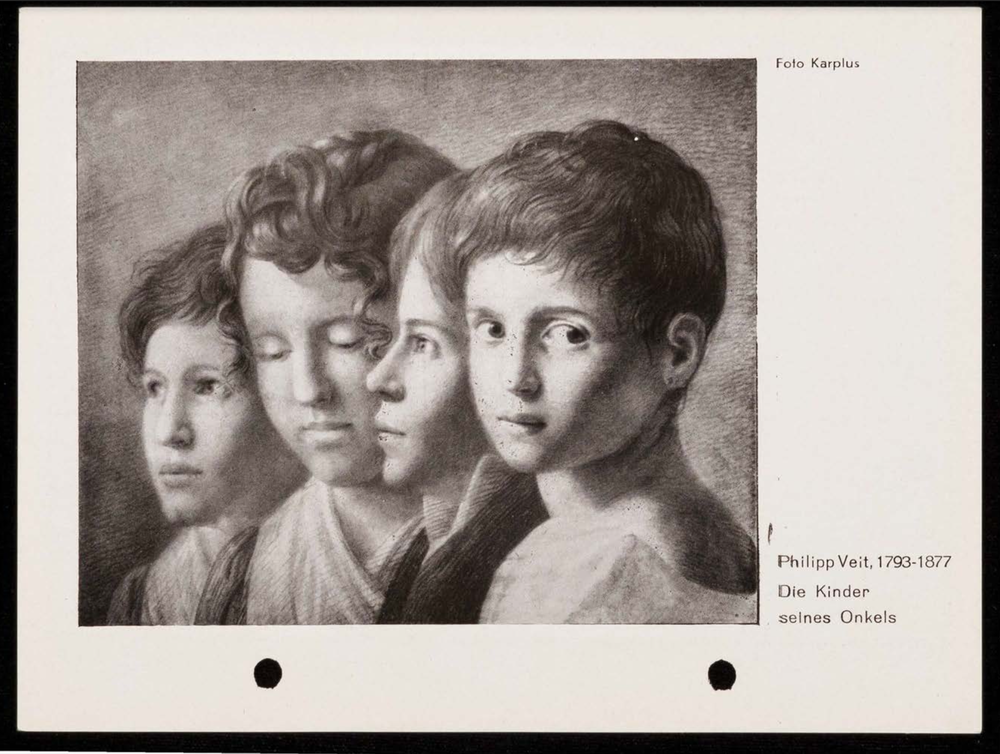
With Jews being persecuted on the streets, the editors of the calendar sought to encourage and foster Jewish people’s resilience by portraying the Jewish family as a source of strength, solidarity and continuity. As Nazi persecution increasingly excluded Jews from public life, Jews receded back into their homes. The family and the Jewish community became an increasingly important focal point, a refuge offering solidarity, advice, and a protected sphere in which to be Jewish. In dark times, the calendar helped Jewish women and men keep track of time, offering a culturally Jewish way of understanding it, as many German Jews increasingly felt that their days in Germany were numbered.
By 1938, mounting antisemitic legislation and discrimination against Jewish people in Germany had led many Jews to consider leaving their homeland for safer havens. Many families faced difficult conversations and were compelled to make painful choices, which tore families apart and scattered them across Europe and the world: Who will stay behind and who will leave?
In this context, the JFB’s calendar can be read as an attempt to reinforce values that became especially urgent for Jews during the Nazi period: the centrality of family, religion as a source of resilience, and the strengthening of Jewish identity. This is captured most vividly in one of the quotes, taken from a will from 1875, in which a parent implores their children to be good Jews, study the Torah, give charity and remain steadfast in their Jewish identity (p. 15v). Readers in 1938 may read this as a message directed at them but may also understand it as a message to pass on to their own children.
The difficulties faced by Jews in 1938 are particularly well encapsulated in a quote by the Jewish poet, philosopher and critic Margarethe Susman (1872–1966). Although she speaks of the challenges of raising children, contemporary readers may identify with the child in her quote, who takes fate in their hands as they grow up:
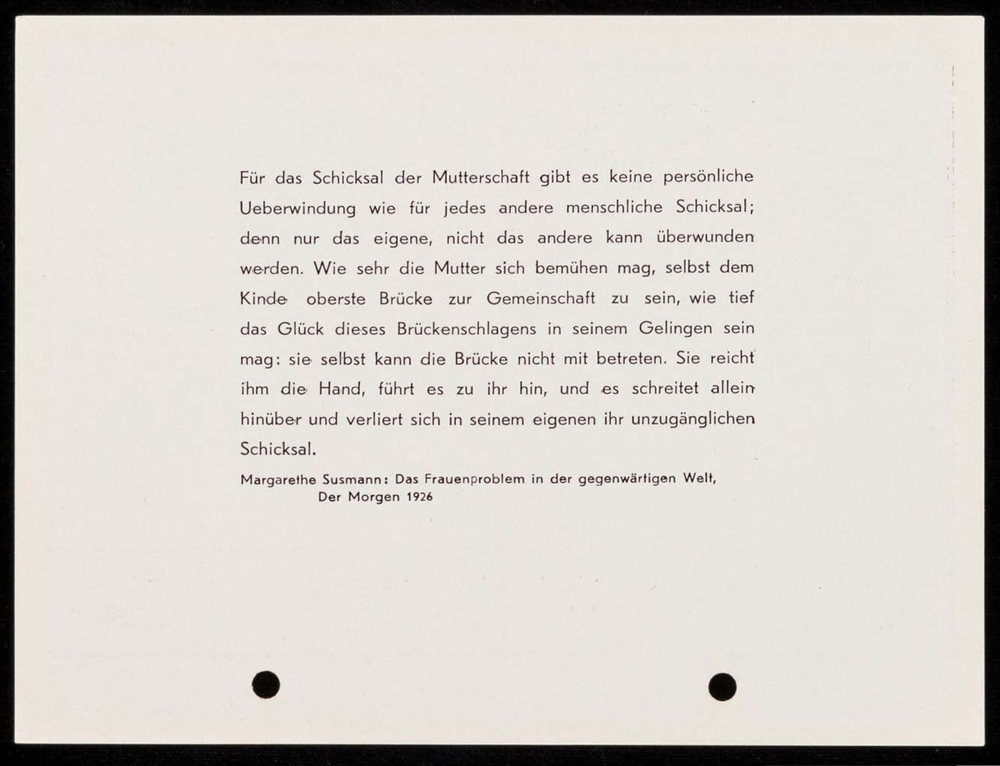
For the destiny of motherhood, there is no personal overcoming as there is for every other human destiny; for only one’s own fate, not that of another, can be overcome. However much the mother may strive to be the child’s supreme bridge to the community, however profound the happiness of building this bridge in its success may be: she herself cannot step onto the bridge. She reaches out her hand, leads the child to it, and the child crosses over alone, losing itself in its own destiny, inaccessible to her.
Margarethe Susman, The Problem of Women in the Contemporary World. Der Morgen (1926)
In the first half of the 20th century, printed calendars of all sorts were popular and ubiquitous. Coincidentally, another one in the LBI’s Pamphlet Collection is a pocket calendar published in the same year by the neo-Orthodox community Adass Jisroel in Berlin. Unlike the JFB calendar, it does not include quotations and contains barely any pictures, but is highly practical, with daily times for putting on Tefillin and Shabbat times as well as a section for personal notes and addresses. In one of the reports in the journal of the JFB, editors Lisbeth Cassirer and Hannah Karminski credit their initiative with contributing to the proliferation of similar calendars among the Jewish community. In 1928, Emil Bernhard Cohn (1881–1948) started to publish a series of Jewish children’s and youth calendars, one of them is also part of the LBI London’s Pamphlet Collection and has been discussed in a previous Snapshot. In 1934, the JFB itself would start publishing their own children’s calendar.
In the final issue of the JFB’s calendar, the editors sought to convey not only Jewish family values but the importance and power of Jewish continuity. The calendar is thus a powerful record of how Jewish women sought to preserve Jewish identity, community and values. The calendar marks a moment of rupture – it ends in September 1939, when the destruction of European Jewry by the Nazis and their collaborators reached another level with the outbreak of the Second World War. But the calendar tells a story of resilience and reassurance that Jewish people – and Jewish women – have a history, dignity and future. Though this is what the Nazis sought to deny them, the calendar in our collection is a testament that they failed.
| Do you or your institution have a copy of one of the calendars of the Jüdische Frauenbund? Printed between 1927 and 1938, they offer an intimate glimpse into the everyday world of German-Jewish women. Apart from the 1938/9 calendar, held by the LBI London, we were only able to locate four other copies at the LBI New York (1938) and the National Library of Israel (1928, 1934, 1938). We would be delighted to hear from you should you know of any other surviving copies of the Frauenbund calendars. |
Further Reading:
Blätter des Jüdischen Frauenbundes (1924–1938), https://sammlungen.ub.uni-frankfurt.de/cm/periodical/titleinfo/4804947.
Bertelli, Francesco. “A brief history of calendar design.” UX Collective. Oct 10, 2018. URL: https://uxdesign.cc/a-brief-history-of-calendar-design-c3f876689fed.
Bloch, Kinga, Carina Chitayat and Daniel Wildmann. “A Compass for a German-Jewish Childhood: Emil Bernhard Cohn’s Jüdischer Jugendkalender1934 (Almanac for Jewish Youth),” Leo Baeck Institute London. URL: https://www.lbilondon.ac.uk/research/snapshots/compass-german-jewish-childhood-emil-bernhard-cohns-judischer-jugendkalender.
Daemmig, Lara and Marion Kaplan. “Juedischer Frauenbund (The League of Jewish Women).” Shalvi/Hyman Encyclopedia of Jewish Women. 27 February 2009. Jewish Women’s Archive. URL: https://jwa.org/encyclopedia/article/juedischer-frauenbund-league-of-jewish-women.
George, Tanya. “Calendar Design in the Online Archive.” Letterform Archive. Jan 18, 2024. URL: https://letterformarchive.org/news/calendar-design-in-the-online-archive/.
Kaplan, Marion. The Jewish Feminist Movement in Germany: The Campaigns of the Jüdischer Frauenbund, 1904–1938. Westport, CT: Greenwood Press, 1979.
Wobick-Segev, Sarah. Homes Away from Home: Jewish Belonging in Twentieth-Century Paris, Berlin, and St. Petersburg. Stanford: Standford University Press, 2018.
Wulf, Marlene. “Der Jüdische Frauenbund.” Leo Baeck Institute Collections. URL: https://www.lbi.org/collections/german-jewish-feminism-in-the-twentieth-century/der-j%C3%BCdische-frauenbund/.