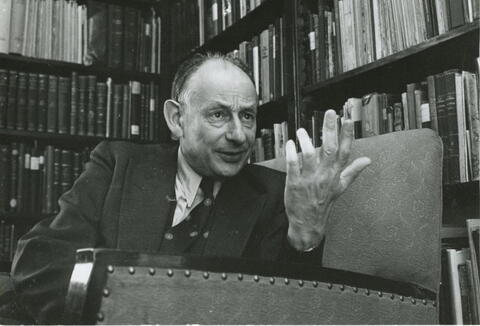
Gershom Scholem (1897–1982) remains one of the most influential figures in modern Jewish scholarship. Born Gerhard Scholem in Berlin into a cultured, assimilated Jewish family, his early life was marked by a profound intellectual rebellion. At a young age, he rejected the secular rationalism dominant in German-Jewish circles, turning instead to Jewish mysticism – the Kabbalah – which had been neglected or disparaged within traditional Jewish studies. Emigrating to Jerusalem in 1923, he adopted the Hebrew name Gershom and devoted his life to the rigorous study of Jewish mysticism. His scholarship reshaped the understanding of Jewish history by revealing the centrality of mystical, messianic, and often revolutionary currents within Judaism.
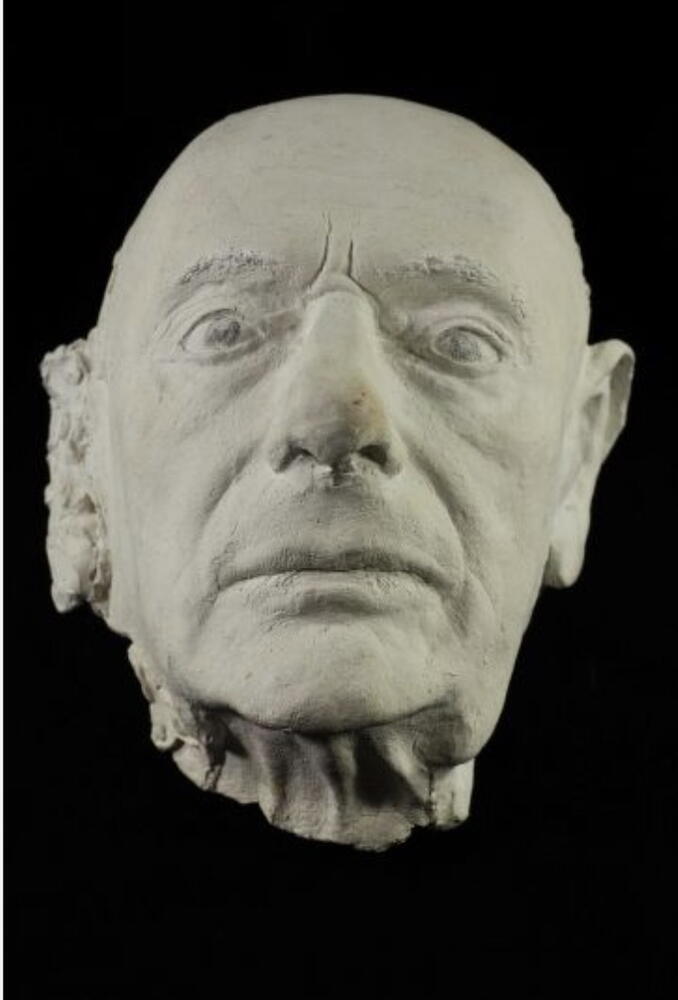
Numerous documents illuminating Scholem’s life and intellectual evolution are preserved in the archives of the Leo Baeck Institute. In addition to an extensive body of writings by and about him, the Institute maintains a dedicated Gershom Scholem collection that includes correspondence with friends and colleagues, manuscripts, lectures, and scholarly essays. Among its most striking items is a rare death mask of Scholem, one of several similar artefacts held by the LBI New York.
Scholem challenged the dominant paradigm of the Wissenschaft des Judentums – the nineteenth-century German-Jewish scholarly tradition – which sought to frame Judaism as a rational, historical religion compatible with modern liberal thought. He famously lamented that this tradition pursued ‘the decent burial of Judaism’, marginalising the esoteric and emotional dimensions of Jewish life. Instead, he articulated what he called a ‘counter-history’, a necessary corrective that placed mystical traditions and irrational forces at the heart of Jewish identity and historical experience (Biale, 1979, p. 7).
His seminal work, Major Trends in Jewish Mysticism (1941), became a landmark text, illuminating the symbolic and theological richness of Kabbalah, from the medieval period to the early modern Sabbatean movements. Scholem demonstrated how these traditions, far from being regressions or heresies, served as engines of Jewish creativity and survival through history’s cataclysms. As he reflected, ‘The Bible and the apocalyptic writers know of no progress in history leading to redemption … The redemption is not the product of immanent developments such as we find in modern Western reinterpretations’ (Scholem, 1971, p. 10).
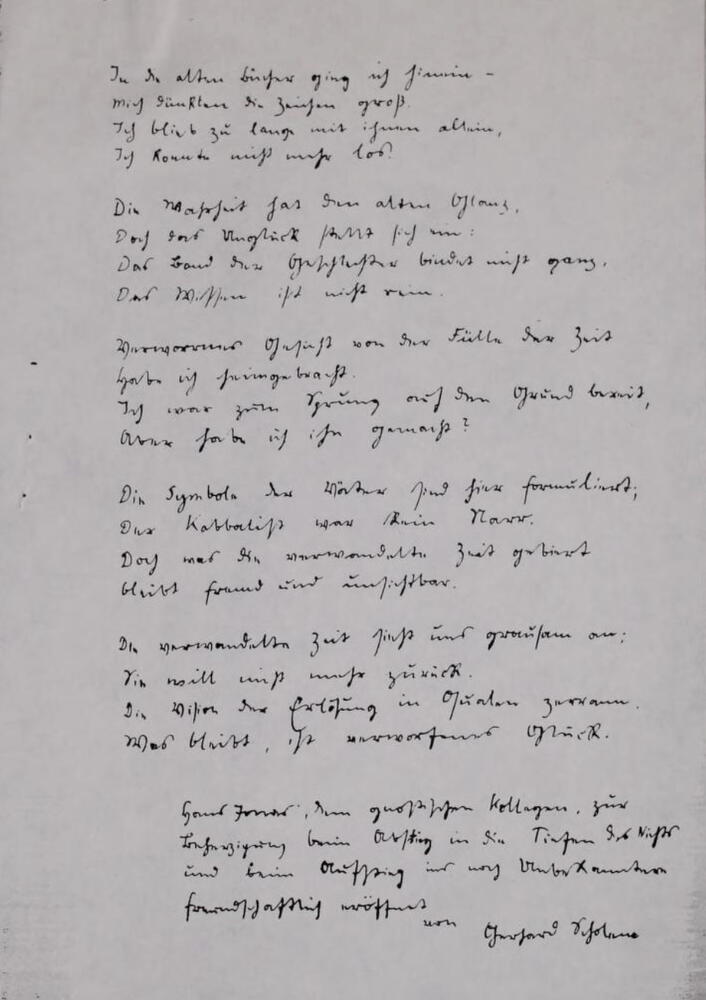
In the LBI archive is the front flyleaf of a second copy of Major Trends in Jewish Mysticism bearing the author’s handwritten poetic dedication to the German-Jewish philosopher Hans Jonas (‘the gnostic colleague’). Jonas was stationed in Palestine with the British Army in 1943. It is recorded that the book was passed on to him by Ernst Simon, a friend of Scholem’s and fellow member of Brit Shalom (‘covenant of peace’), a group of Zionist intellectuals committed to fostering peaceful coexistence between Arabs and Jews in Mandatory Palestine. In this way, the archival item reflects the intertwined threads of Scholem’s life, scholarship, and enduring relationships.
|
In die alten Bücher ging ich hinein - Die Wahrheit hat den alten Glanz, Verworrenes Gesicht von der Fülle der Zeit Die Symbole der Väter sind hier formuliert; Die verwandelte Zeit sieht uns grausam an; Hans Jonas, dem gnostischen Kollegen, zur Beherzigung beim Abstieg in die Tiefen des Nichts und beim Aufstieg ins noch Unbekanntere freundschaftlich eröffnet von Gerhard Scholem |
I went into the old books – Truth still has its ancient shine, A face confused by the fullness of time The symbols of the fathers are formulated here; Transformed time gazes at us cruelly; To Hans Jonas, the gnostic colleague, for reflection during his descent into the depths of nothingness and his ascent into the still more unknown – shared in friendship by Gerhard Scholem. |
A critical figure in Scholem’s intellectual and personal life was the philosopher Hannah Arendt. Their friendship, spanning the late 1930s to the early 1960s, was one of profound mutual respect and shared concerns despite deep disagreements. Both German Jews who grappled with the impossibility of Jewish life in Europe under fascism, their correspondence reveals a dialogue on Jewish identity, history, and politics conducted against the backdrop of the Holocaust and the founding of Israel.
Arendt, younger by nearly a decade, emerged from the Christian-influenced European intellectual tradition, while Scholem’s path was rooted in Jewish mystical revival and a Zionist cultural vision centred in Jerusalem. Their exchanges began in 1939 in Paris and continued mainly through letters across continents for over two decades. They mourned the death of Walter Benjamin, a mutual friend, and collaborated intensively in efforts to salvage Jewish cultural artefacts looted by the Nazis through the Jewish Cultural Reconstruction organization. This work was fundamental in preserving invaluable archives and manuscripts, many now accessible in Israeli institutions where Scholem taught.
However, political tensions surfaced, especially after Arendt’s controversial articles ‘Zionism Reconsidered’ (1946) and her book Eichmann in Jerusalem (1963). Scholem, a committed Zionist, was deeply hurt by Arendt’s criticisms of Israeli politics and her portrayal of the Holocaust’s Jewish councils. Their friendship, always marked by passionate debate and delicate balancing of differences, ended after the Eichmann controversy.
Nevertheless, their correspondence remains a testament to the intellectual vitality and emotional complexity of Jewish thought in the twentieth century. Scholem’s description of letters as a ‘messianic moment’ – a space where human existence transforms into script – aptly captures the spirit of their dialogue. Despite distance and occasional discord, their exchanges were ‘thin, strong threads’ holding together a shared commitment to Jewish renewal (Knott, 2017, pp. x–xi and xiv).
Scholem’s legacy, cherished by institutions like the Leo Baeck Institute London, stretches beyond his pioneering academic contributions. His life embodies the enduring struggle to reclaim Jewish history in its full depth and diversity, challenging simplistic narratives to reveal a tapestry interwoven with paradox, hope, and profound spirituality. As he once wrote, the Kabbalists ‘know something we don’t’, a deeper human experience encoded in ancient symbols, awaiting rediscovery and renewal.
Bibliography
Biale, David, Gershom Scholem: Kabbalah and Counter-History (Cambridge, Mass.: Harvard University Press, 1979)
Knott, Marie Luise (ed.), The Correspondence of Hannah Arendt and Gershom Scholem (Chicago: University of Chicago Press, 2017)
Scholem, Gershom, Major Trends in Jewish Mysticism (Jerusalem: Schocken Publishing House, 1941)
Scholem, Gershom, The Messianic Idea in Judaism: And Other Essays on Jewish Spirituality (New York: Schocken Books, 1971)
Images: LBI NY