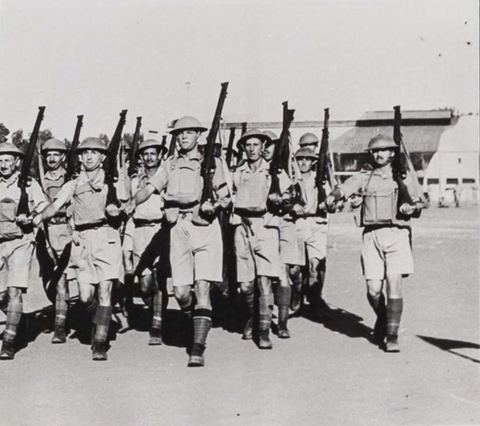
In August 1944, Winston Churchill telegrammed Franklin D. Roosevelt, sharing his plan to establish a Jewish “regimental combat team” (Lubshinski-Katko, 2005, p. 112) in Mandatory Palestine. The team would later become the Jewish Brigade Group—a unit composed of Jewish volunteers, many of them German-speakers. Photographs of the Jewish Brigade at various stages of its formation found their way into our collection thanks to Robert Weltsch, the first director of the Leo Baeck Institute, who, having escaped Nazi Germany to Mandatory Palestine, worked there as a journalist throughout the Second World War.
The road to the establishment of the Jewish Brigade was anything but smooth. From the very outset of the war, the position of the Yishuv—the Jewish community of Mandatory Palestine—was clear: to take the fight to the Nazis. The determination was encouraged by organisations such as the National Committee for the Jewish Soldier, which promoted annual Jewish Soldier’s Day to honour Jewish volunteers in the British Army, and by various periodicals, which consistently advocated for the urgency of enlistment. Yet, the response from the British authorities was, at best, hesitant. They feared that allowing a distinct Jewish combat force would provoke local unrest, and they were wary of providing the Yishuv with military training that might later be turned against the Mandate authorities themselves. Thus, as early as 1939, thousands of Jews from Mandatory Palestine had volunteered for service, only to find themselves assigned to non-combat roles, such as lines of communication, far from the front lines they had hoped for.
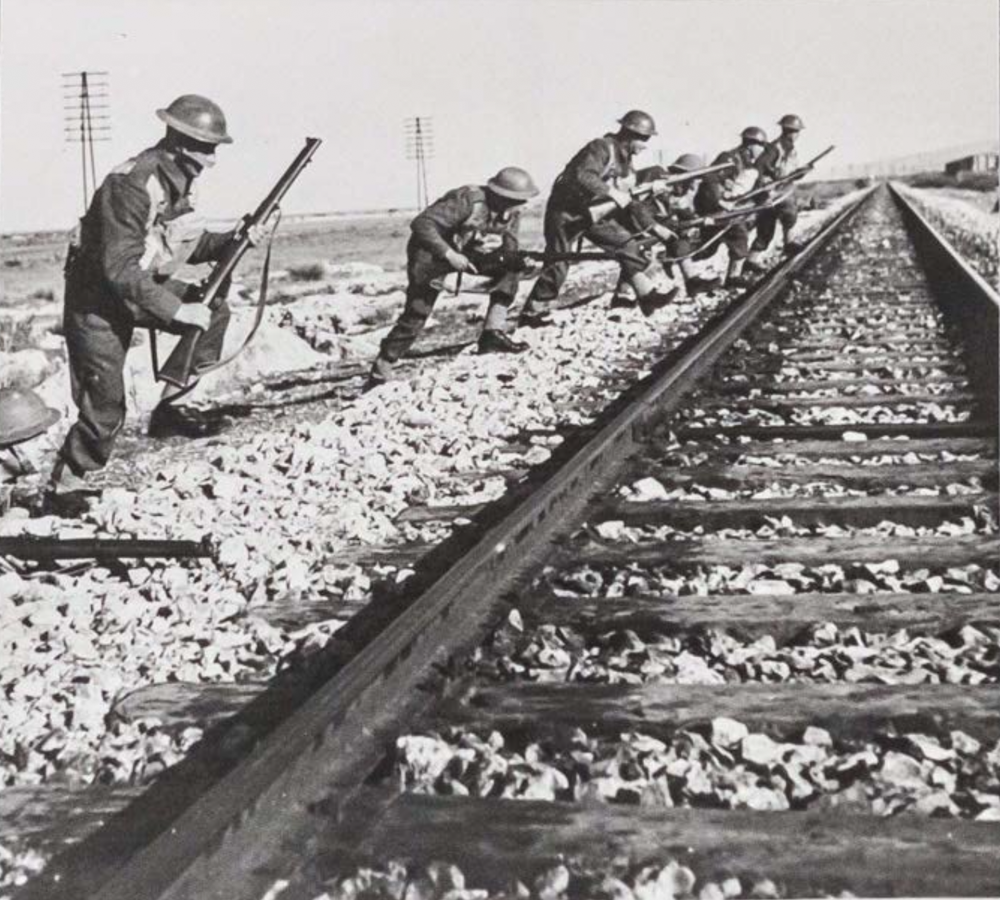
For a long time, despite repeated appeals from the World Zionist Congress and the Jewish Agency, Jews of the Yishuv were denied a Jewish unit, a frustrating impasse for a community eager to fight under its own flag. However, a shift came when Hitler’s forces pushed across North Africa in 1942. With mounting pressure to redeploy its troops, the British War Office created the Palestine Regiment, a unit to be part of the Royal East Kent Regiment (also known as “the Buffs”), and its battalions included Jewish and Arab recruits from Mandatory Palestine.
At the time, the “Jewish Buffs” came the closest to fulfilling the Yishuv’s dream of having an all-Jewish infantry unit. This group numbered around 1,500 men (Jackson, 2006). Yet, following the victory over the German forces in North Africa, the “Jewish Buffs” were reassigned to guarding prisoners of war and later sent to remote desert training camps. As news of the Holocaust flooded the Middle East, the Jewish soldiers remained stationed far from the battlefields, wallowed in drills, training exercises, and guard duties throughout 1942 and 1943. What had once seemed like a significant step toward Jewish military resistance against the Nazis now felt like an endpoint to Yishuv’s role in the war.
However, distinct Jewish combat units were not the only avenue through which Yishuv Jews could contribute to the war effort. For example, an unusual formation was composed of the German-speaking Yishuv volunteers in 1942. Called Special Interrogation Group, better known as SIG, this formation was made up of “fluent German linguists … mainly Palestinian (Jews) of German origin” (General Airey, 1942, as quoted in Sugerman, 2010, p. 153), tasked with infiltrating German lines in Africa and sabotaging operations from within. Their language and cultural fluency made German Jews uniquely suited to this work.
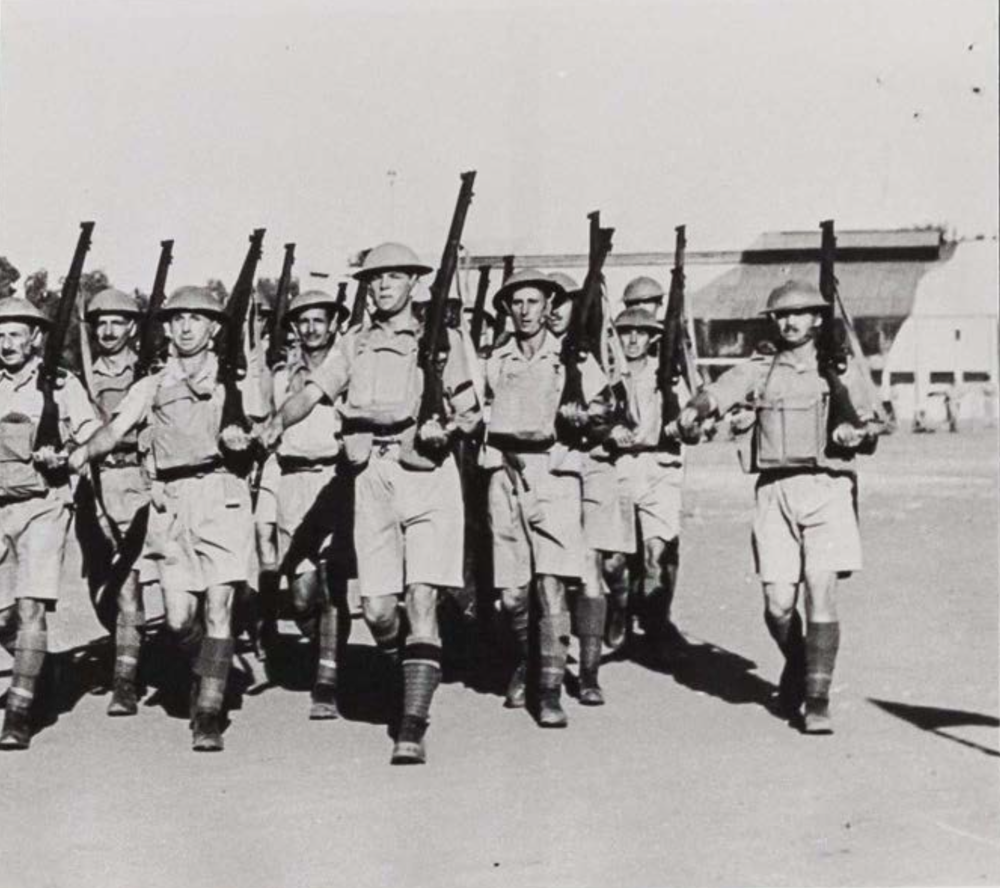
Conceived by British officer Herbert Buck, SIG was “virtually a suicide squad” (Miller, 1981, p. 84). The risks to the operatives could not have been clearer: capture meant execution. Even so, dozens of men volunteered, including soldiers from the “Jewish Buffs”. Cut off from other British units, SIG was trained in everything, from desert navigation to handling German weapons, and the training was conducted entirely in German. The recruits were expected not just to act like German soldiers, but to live as them—know their army songs, master military slang and routines, maintain their cover at all times. Eventually, disguised as Afrika Korps troops, SIG operatives carried out a few successful sabotage missions. However, after the failed Tobruk raid, in which several operatives were killed, the SIG was disbanded and its surviving members transferred to the Royal Pioneer Corps.
In the wake of the Normandy landings of 1944, after years of stalemate, the World Zionist Congress and the Jewish Agency once again appealed to Churchill to establish a Jewish fighting force in the Mandatory Palestine, and this time, they were heard. On 20 September 1944, despite the objections of the War Office and Colonial Office, Churchill announced the creation of the Jewish Brigade—formally the Jewish Infantry Brigade of the British Eighth Army.
“It seems to me indeed appropriate that a special Jewish unit, a special unit of that race, which has suffered indescribable torments from the Nazis, should be represented by a distinct formation amongst the forces gathered for their final overthrow” (Churchill, 1944, as quoted in Olin 1998, 14:23 – 14:45).
Jewish Brigade was the only military formation to fight in World War II as the official representative of the Jewish people as a nation, and it numbered more than 5,000 men. For their uniform insignia, the Jewish Brigade chose not the familiar blue Star of David, but a yellow one, reclaiming the symbol the Nazis used to persecute Jews.
Soon after its official creation, the Brigade was sent to a training camp in Egypt, where it held its first parade in the Western Desert. There, for the first time, Jewish soldiers officially raised the flag of their unit—the flag that would later become the flag of Israel.
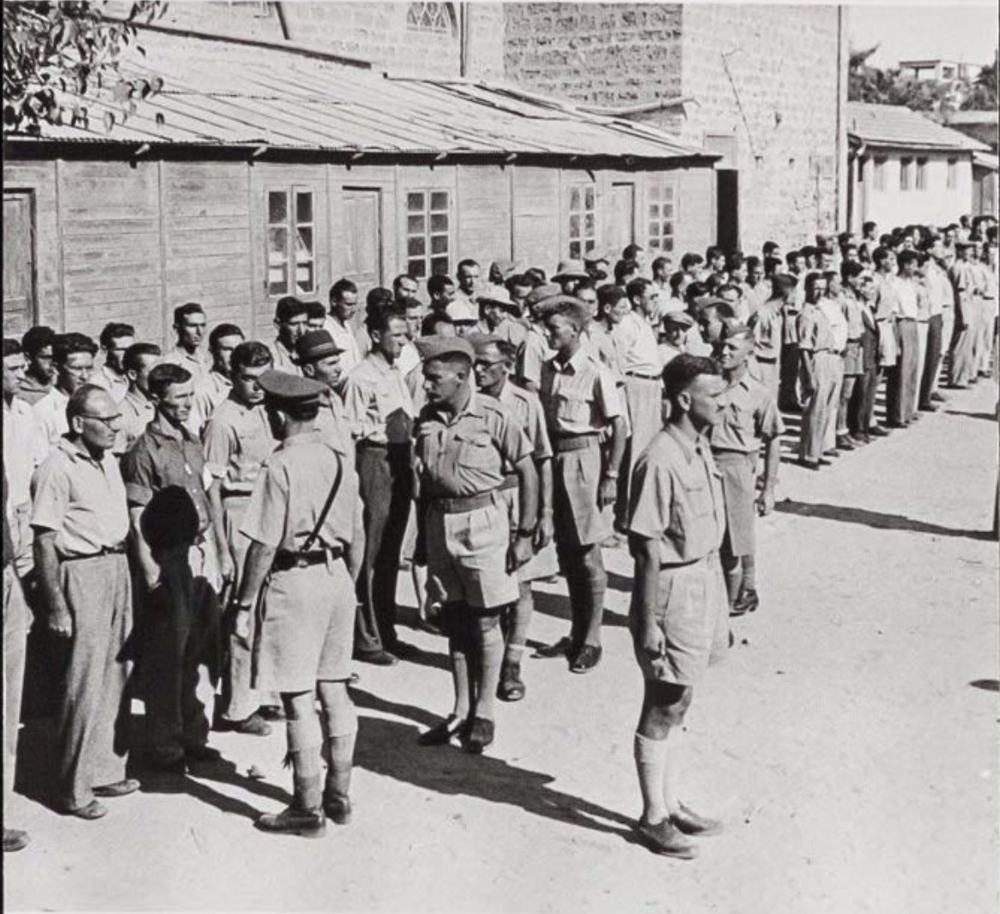
The Jewish Brigade took to the front lines in Italy in March 1945. It supported local resistance, hunted down enemy forces in hiding, and repeatedly clashed with German troops as it advanced through the country. Made up of infantry battalions backed by artillery, signals, and engineering units, the Jewish Brigade participated in the so-called Operation Grapeshot—the final Allied attack in Italy that led to the surrender of Axis forces there. The Brigade’s impressive performance did not go unnoticed: their corps commander praised their eagerness to take on the enemy, saying that the Brigade’s staff work and judgment “were good” and they would be a welcome addition to any field force (Beckman, 2008, p. 103).
After the war, Jewish soldiers were stationed at the border triangle of Italy, Yugoslavia, and Austria, where they became a point of contact for many Holocaust survivors. In the following months, hundreds of Brigade soldiers clandestinely worked in displaced persons camps, assisting with efforts to facilitate immigration to Mandatory Palestine, and many were involved in supporting the Briha (“Escape”) networks in Austria and Germany.
In line with British demobilisation plans, the Jewish Brigade was ultimately disbanded in the summer of 1946.
Bibliography
Beckman, Morris. The Jewish Brigade: An Army with Two Masters, 1944–1945 (Stroud, Gloucestershire : Spellmount, 2008).
Blum, Howard. The Brigade: An Epic Story of Vengeance, Salvation, and WWII (New York : HarperCollins, 2001).
Casper, Bernard. With the Jewish Brigade (London : Edward Goldston, 1947).
Gelber, Yoav. The Struggle for a Jewish Army: Jewish Palestinian Volunteering in the British Army During the Second World War II (Jerusalem: Yad Ben-Zvi, 1981).
Jackson, Ashley. The British Empire and the Second World War (London; New York : Hambledon Continuum, 2006)
Lubshinski-Katko, Tamar. Halochem Hayehudi Bemilchemet Haolam Hesheniya (“The Jewish Fighter in World War II”) (Shiryon Press, 2005).
Miller, Russell. The Commandos (Time-Life Books, 1981).
Olin, Chuck, dir. In Our Own Hands: The Hidden Story of the Jewish Brigade in World War II (Olin-Cooper Productions, 1998). DVD.
Sugerman, Martin, “Lions of Judah: The Jewish Commandos of the SIG.” Jewish Virtual Library, 2010: 153-177. https://jewishvirtuallibrary.org/jsource/Holocaust/sig.pdf.