Skip to main content Leo Baeck Institute London | Leo Baeck Institute London

Leo Baeck Institute London

Leo Baeck Fellowship Programme Online Workshop Nov-Dec 2024

18th, 20th of November, 2nd, 9th  December 2024
4.00-6.00pm Berlin Time


Participants:

Aebischer, Emilie: Writing History in the Face of Fanaticism: Ernst Cassirer and his Reception as a Historian (University of St. Andrews, History)

Aizenberg, Tamar: The Third Generations: Grandchildren of Holocaust Survivors, Grandchildren of Perpetrators and Holocaust Memory (Brandeis University, Jewish Studies)

Library of Lost Books nominated for the Grimme Online Award

4 September 2024

We are excited to share the news that the Library of Lost Books has been nominated for this year’s Grimme Online Award, a prestigious German media prize.

Votes are now open so please help us by voting and sharing with others. Your support will make all the difference!

Vote here: https://w1.grimme-online-award.de/goa/voting/ext_voting.pl 

And read more details about our nomination: https://www.grimme-online-award.de/2024/nominierte/nominierte-detail/d/library-of-lost-books 


Interview with LBI London Director Dr Joseph Cronin and Deputy Director Kinga Bloch

28 August 2024

The Friends and Supporters of the Leo Baeck Institute in Berlin have published an interview on their website looking at the work of our Director and Deputy Director. Excepts can be read below and a link to the full article (in German) is at the bottom of the page.


Joseph Cronin

When Joseph Cronin began working at the Leo Baeck Institute as a young doctoral student in 2012, he got to know some first-generation German-Jewish emigrants at board meetings – while serving coffee, as he recalls. Dr. Joseph Cronin has headed the Leo Baeck Institute London since September 2023.

The Luzzatto Manuscript

26 June 2024

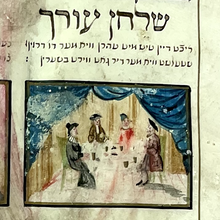
Samuel David Luzzatto’s Synonymia Hebraica (Mavdil Nirdafim) (c. 1815–1820) is a remarkable manuscript smuggled out of Germany by Alexander Guttmann in 1940. 

This beautifully bound notebook contains 25 essays in Hebrew, each exploring groups of words in the Bible with similar or identical meanings. All but one essay were later published in the journals Bikkurei Ha-Ittim (1825–1828) and Jeschurun (1856).  

What makes this item unique are the author’s corrections and notes in the margins, written in ink, crayon and pencil. It is thus a fascinating testament to the editing process. This item is on permanent loan to the Leo Baeck College Library from the Judaica Conservancy Foundation. 

Regina Jonas – The First Woman Rabbi

Can women hold rabbinical office? This was one of the questions discussed at the Higher Institute for Jewish Studies, Berlin, in the 1920s and 1930s. And no one was better suited to provide an answer to this than Regina Jonas, a student at the Higher Institute who became the first female rabbi in the world in 1935. Prior to her ordination, Jonas answered the question about women’s access to the rabbinate in a halachic treatise that she submitted in 1930 as her final halachic project.

More Light – Art Against Hate: Fighting Holocaust Denial and the Rise of Right-Wing Nationalism in Poland

The ability to accurately describe the past is not confined to historians alone. Artists use their creative expression to explore the cruelties of history, aiming to shape a more ethical present and future. In the case of Grzegorz Kwiatkowski, art is also mixed with activism and active efforts to preserve the memory of the victims and their cultural heritage.

A German-Jewish Athlete during the Age of Extremes: Alex Natan (1906–71)

As a gay high-performance runner, antifascist intellectual and sportswriter, Alex Natan was a quintessential outsider in Weimar Berlin. His marginal status also remained a constant during his forced emigration to Britain, as a precarious refugee in pre-war London, as a long-time internee during World War II, as well as a schoolteacher in the Midlands and author and journalist in post-war Britain and West Germany.

LBI London Summer Lecture: Psychologists in Auschwitz: Accounting for Survival

The writings of Dutch Auschwitz survivors Eddy de Wind, Elie Cohen and Louis Micheels merit analysis not only because they anticipated what later became known as PTSD and much of the underpinnings of trauma theory. They also advocated a theory of survival that offers a compelling contrast to well-known “self-help” theories put forward by Bruno Bettelheim and, especially, Viktor Frankl.

Subscribe to our Newsletter

Latest Publications