Skip to main content Leo Baeck Institute London | Leo Baeck Institute London

Leo Baeck Institute London

Commemorating the Musical Legacy of Fanny Hensel

14 May 2026

We mark the anniversary of the death of the composer Fanny Hensel, née Mendelssohn Bartholdy, who died on 14 May 1847. A central figure in Berlin’s cultural life, Hensel composed over 450 works, encompassing lieder, piano pieces, and chamber music.

Hensel’s life was characterised by a close musical partnership with her brother, Felix Mendelssohn, whom she described as her ‘right hand and my eyesight’. Despite nineteenth-century social constraints that restricted her public career, her Sunday musicales on Leipzigerstrasse provided a vital space for the city’s highest musical achievements. Contemporaries recorded that she conducted and performed with a force and depth that commanded the room.

The Anniversary of the 1933 Book Burnings

10 May 2026

On 10 May 1933, student groups across Germany organised the public burning of thousands of books deemed ‘un-German’. The campaign targeted works by Jewish authors, political dissidents, and intellectuals whose ideas the National Socialist state considered a threat.

Earlier that spring, Leo Baeck observed that the history of Jews in Germany had effectively concluded. In the ensuing years, the Jewish community responded to this cultural exclusion with spiritual resistance. Publishers such as Schocken Verlag provided a refuge for a community barred from German public life by printing and preserving works of Jewish literature.

Marking VE Day

8 May 2026

The Leo Baeck Institute London observes VE Day, marking the end of the Second World War in Europe. This anniversary holds particular significance for the Institute, as it coincides with the liberation of our namesake, Rabbi Dr Leo Baeck, from the Theresienstadt ghetto in May 1945.

Uncovering a Pioneer of Jewish Law

5 May 2026

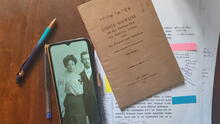
LBI London intern Katharina Hadassah Wendl has published an article exploring the work of a 1920s Neo-Orthodox woman. Raised in Frankfurt’s Neo-Orthodox community, Gella Sänger became the ‘first woman to have authored and published a handbook on Jewish law’.

Her handbook, Ishah el Achotah, sought to make ‘halachic (Jewish legal) discourse more accessible to a broader audience, especially their fellow Jewish women’. Despite achieving popularity upon publication, Sänger and her text became unacknowledged within the history of women writers. Wendl’s analysis reveals how Sänger’s engagement in halachic discourse foreshadowed the movement of Orthodox women writing about Jewish law that emerged in the 1980s.

Tags

The Life and Legacy of Gustav Landauer

1 May 2026

The Leo Baeck Institute London commemorates the anniversary of the death of Gustav Landauer, who was murdered on 2 May 1919. A prominent anti-Marxist anarchist, literary critic, and philosopher, Landauer was a central figure in the cultural and political life of German-speaking Jewry. He was a close friend of the philosopher Martin Buber, for whom he became an enduring model of ‘social mysticism’ and active love of neighbour.

Landauer served as a delegate for public enlightenment in the revolutionary republic of Bavaria before his assassination by counterrevolutionary troops. His commitment to humanitarian ideals and his belief that revolution was a permanent process of regeneration remain a vital part of our intellectual history

Rabbi Baroness Julia Neuberger on BBC Panorama

21 April 2026

Last night, 20 April, BBC Panorama broadcast ‘Antisemitism: Why British Jews Are Afraid’, an episode examining the rise in antisemitism in the UK and its effect on Jewish life in Britain.

LBI London Executive Member Rabbi Baroness Julia Neuberger spoke in the programme about how “people use the cover of criticising the actions of the Israeli government to be antisemitic”.

The episode also explored how antisemitism is being experienced in public life, including in schools, hospitals and workplaces. It reflected concerns heard across the British Jewish community about safety, visibility and the impact of hostile language both online and offline.

Tags

Leo Haas at 125: Art, Witness and Survival

15 April 2026

On 15 April 2026, the 125th anniversary of Leo Haas’s birth offers an opportunity to remember an artist whose work became part of the historical record of Nazi persecution. Born in Czechoslovakia in 1901, Haas trained in fine art and later worked as a graphic designer before his life was upended by the rise of Nazism.

In 1937, the authorities classified his work as ‘degenerate art’, part of a wider campaign against modern and Jewish artists under the regime. During the war, Haas was deported to the Theresienstadt ghetto in 1942, where he was assigned to the technical-graphic department. That official role gave him access to materials, but it also placed him in a position of great danger when he began to make drawings in secret.

Voices Across Borders: Dr Monja Stahlberger on Exile, Memory, and the Kindertransport

Tags

LBI London recently sat down with Dr Monja Stahlberger, who has just completed a Postdoctoral Fellowship at the Institute, where her research explored how German-Jewish exile families transmitted cultural memory across generations and national borders. Drawing on personal archives, diaries, and letters held in collections from London to Vancouver, Stahlberger’s work illuminates the deeply human dimensions of forced migration that official records so often miss.

Subscribe to the LBI's monthly newsletter

Latest Publications