Skip to main content Leo Baeck Institute London | Leo Baeck Institute London

Leo Baeck Institute London

Gershom Scholem: A Revolutionary Scholar of Jewish Mysticism

3 December 2025

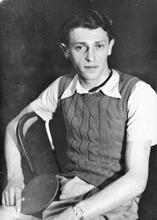
On 5 December, we commemorate the birthday of Gershom Scholem (1897–1982), one of the foremost historians and thinkers of modern Jewish culture. Scholem’s profound and sustained scholarship transformed the study of Jewish mysticism, particularly the Kabbalah, establishing it as a fundamental part of Jewish historiography rather than an esoteric marginalia. Born into the German-Jewish milieu of Berlin and emigrating to Jerusalem in 1923, Scholem’s life and work bridged the cultural worlds of Europe and Palestine, reflecting the tumultuous debates and crises of Jewish identity in the twentieth century.

Applications for the Leo Baeck Fellowship Programme 2026/27 now open

28 November 2025

We are happy to advertise the international Leo Baeck Fellowship Programme 2026/2027 (German academic year October 2026-September 2027). We invite applications from PhD students who carry out research into the field of German-Jewish history and culture. The programme is jointly organised by the Leo Baeck Institute London, the Leibniz Institute for Jewish History and Culture – Simon Dubnow in Leipzig and the  Studienstiftung des deutschen Volkes. Our programme is open to PhD candidates worldwide. The deadline for application is February 1st, 2026.

More information and how to apply: https://www.lbilondon.ac.uk/fellowship


Efraim Frisch – Editor, Essayist, European

Efraim Frisch (1873–1942) was a writer and editor of the journal Der Neue Merkur, which from 1914 to 1925 provided a forum for liberal, international, and democratic voices. Raised in an Orthodox family in the Galician town of Brody, he turned early to secular studies and literature, without ever completely abandoning his religious roots. He moved in the circles of figures such as Martin Buber, Heinrich Mann and Christian Morgenstern, and was intellectually closely accompanied by his wife, the translator Fega Frisch.

LBI London moves to Senate House

17 November 2025

The LBI London relocated to Senate House last month, bringing us closer to our academic partner Birkbeck and the venue for many of our lectures. Our move this time was a short one, just across the road from the premises we moved to after leaving Queen Mary University of London last year.

Senate House offers us a more permanent and prestigious home in central London, and strengthens our ability to support advanced research and public engagement with German-Jewish history and culture within a vibrant academic community.

Eva Reichmann: Witness, Historian, Legacy — Inaugural Lecture Marks LBI's 70th Anniversary

11 November 2025

The inaugural Eva Reichmann Memorial Lecture was held last Thursday evening at The Wiener Holocaust Library, as part of the Leo Baeck Institute’s international 70th anniversary celebrations. Dr Eva Reichmann was a pioneering historian whose work has profoundly influenced Holocaust scholarship and our understanding of antisemitism and persecution under the Nazi regime.

Night of Broken Glass

8 November 2025

This photograph from the Leo Baeck Institute New York collection (F 13380) reveals the damage to a Jewish clothing shop in Magdeburg after the Kristallnacht pogrom on 9 November 1938. The shattered glass of the shop window stands as a stark symbol of the violence inflicted on Jewish businesses and the wider community that night. Locals are seen hurrying past the wrecked shopfront, a chilling reminder of the destruction that ravaged German Jewish life.

The German Case: What It Tells Us About Antisemitism Worldwide

Once the driving force of antisemitism worldwide, Nazi Germany waged war against Jews everywhere, radicalising antisemitism in word and deed. After 1945, Germany was pacified by the Allies, and open antisemitism became the antithesis of the new democratic Staatsräson. Yet today, antisemitism has returned – from the far right, parts of the radical left, Islamist movements, and the centre of society.

Europeans in the Raj: German Jews and the Government of India Act, 1935

How did German Jews experience life as refugees from Nazism in the British Empire? Scholars of the Holocaust have often turned to frameworks of racial triangulation to answer this question, emphasizing Jews’ ‘Other-ing’ in Nazi Germany to place refugees ‘in-between’ the binaries of coloniser and colonised, European and non-European. This talk, however, takes a deep dive into the history of Indian constitutional development and legislative reform to understand the place of Holocaust refugees in the racialised socio-political hierarchy of the British Raj.

Meet the Pamphlets: Das Hohelied (1937)

21 October 2025

The Leo Baeck Institute London is pleased to present Das Hohelied, a booklet published in 1937 by the Jewish Community of Berlin for Passover. This pamphlet features the original text of the Song of Songs alongside a lyrical translation, with the hope that ‘this biblical jewel might inspire joy and deepen religious meaning among both young and old’. 

Accompanying the text is a report on the community’s work and commitments, together with an appeal for donations, emphasising that no one should have to observe Passover without a Seder meal and matzot.

Subscribe to our Newsletter

Latest Publications